Translate

Showing posts with label job. Show all posts

Sunday, 21 June 2026

希望傳承者應有的態度 The Proper Attitude of the Messengers of Hope

常年期第十二主日,甲年
主題:希望傳承者應有的態度 The Proper Attitude of the Messengers of Hope

瑪竇宗徒寫福音給有猶太文化背景的信徒,所以在鋪排《耶穌傳》內容的時候,他有意把耶穌基督的傳教生活,編寫成五個部份,有如《梅瑟五書》。每部份先講述耶穌做了甚麼,才講述耶穌教訓些甚麼。第一部份宣佈天國的福音:首先講述耶穌接受若翰洗者的洗禮、三退魔鬼的試探、在加里肋亞開始宣講福音、召選首批門徒,然後記載『山中聖訓』。第二部份宣傳天國,首先講述10個神跡,然後講論傳教事業。上個主日我們聽過12宗徒的名單,已經進入了『宣傳天國』的部份,開始聽取耶穌對傳福音的教訓。這就是今天福音選段的背景,但還未到達上文。

今天的福音選段,一開始便說:「你們不要害怕他們」(瑪10:26)。『他們』是誰呢?為甚麼宗徒們不要害怕『他們』呢?要知道『他們』是誰,便要看上文了!上文是接著上一個主日讀的「病人,你們要治好;死人,你們要復活…」(10:8)。中間一段經文我們沒有在主日讀,而是在平日彌撒讀。例如:「看,我派遣你們好像羊進入狼群中…」(10:16a)。請注意,耶穌不是送12宗徒好像羊一樣『入虎口』,而是告訴12宗徒,他們有幸可以與他們的師傅,一同應驗依撒意亞先知有關『默西亞王國』的預言(5:17),就是:「豺狼將與羔羊共處,虎豹將與小山羊同宿」(依11:6)。所以宗徒們要害怕的,不是與那些豺狼虎豹相處,而是其他事物。

今次是12宗徒第一次出外傳福音,他們會遇到接受福音的『和平之子』(路10:6; 瑪10:13),也會因為治病驅魔,解決民間疾苦而受到群眾歡迎,令司祭、經師和法利塞人的地位受到威脅,引來他們的迫害!所以耶穌指示宗徒們:「要機警如同蛇,純樸如同鴿子」(10:16b)。初出茅廬傳福音,並不是做殉道者的時候。所以,12宗徒要『害怕』那些迫害他們的權貴。耶穌說:「幾時人們在這城迫害你們,你們就逃往另一城去」(10:23)。不要理直氣壯地與他們對抗,反而要『害怕』,要保留性命,讓其他人有聽從福音的機會。倘若天主願意,即使今次「把塵土從你們的腳上拂去」(10:14),下次仍可以捲土重來;又或者為其他傳福音的人鋪路!12宗徒不是救世主,救世主另有其人。宗徒們要謙遜,不要有『捨我其誰』的自大!他們應該尋求天父的旨意,要「機警如同蛇」,審時度勢。不強求成功,不以逃跑為恥。倘若是天主的旨意,就從容就義,喚醒更多的靈魂!

其實,這些宗教或政治權貴並不可怕,所以耶穌在今天的福音選段說「不要害怕他們」(10:26)。聽來有點矛盾。究竟要害怕權貴,抑或是不要害怕他們呢?其實一切應透過祈禱和辨別,來尋求天父的旨意,然後按照天父的旨意實行。耶穌說:「你們不要怕那殺害肉身,而不能殺害靈魂的」(10:28a)。靈魂不是不死不滅的嗎?誰有能力殺害靈魂呢?是撒殫嗎?不是!牠只能傷害我們的肉體,可以引誘我們的靈魂入歧途(約2:6, 9-10),但不能夠殺死我們的靈魂。只有天主才有這能力,因為我們是祂獨自創造的!耶穌繼續說:「但更要害怕那能使靈魂和肉身陷於地獄中的」(瑪10:28b)。即是說,我們應該敬畏那創造我們的天主!
可惜當今世上,即使是信徒,對天主的敬畏與科技發展成反比。科技加強了我們肢體和腦袋的工作能力,卻讓我們陷入不再信靠天主的誘惑!耶穌基督選擇用另外一個圖像,重溫我們是『天主肖像』(創1:26)的崇高地位。所以祂接著說:「兩隻麻雀不是賣一個銅錢嗎…你們不要害怕;你們比許多麻雀還貴重呢」(瑪10:29, 31)!天父不會輕易讓我們的靈魂和肉身陷於地獄中的,因為我們是祂手中的傑作,倘若我們失敗了,天父也要蒙羞(出32:9-12)!

執事,你是否太樂觀了嗎?耶穌不是繼續警告說:「但誰若在人前否認我,我在我天上的父前也必否認他」(瑪10:33)嗎?在香港,天主教徒人數佔全港人口不足10%。我們是『少民族裔』,在香港很低調,很少為社會問題那聲。大部份香港的天主教徒寧願默默工作,也不願在人前表露天主教徒的身份,絕少在公眾地方進食前大膽地唸『謝飯經』…遑論在人前承認『耶穌基督是救世主』,怕傷害別人的宗教情緒;不敢宣講『信耶穌得永生』、『耶穌基督就是真理』,怕被人反駁,被人譏笑…嚴格地說,這些天主教徒不是在人前否認耶穌嗎?這些被耶穌基督在天父前否認的天主教徒,豈不是要陷於地獄中嗎?

執事我會反問,在福音中有誰在人前否認耶穌呢?是出賣耶穌的猶達斯嗎?絕對不是他!就是 猶達斯才有本領帶士兵和警衛到耶穌跟前逮捕祂,難道香港市民可以找那些『隱形天主教徒』幫助他們『捕捉』/認識耶穌嗎?那麼在福音中還有誰人在人否認耶穌呢?當然是大名鼎鼎的西滿伯多祿。伯多祿會下地獄嗎?當然不會,他手握『天國的籲匙』,倘若他在地獄,誰可以打開天堂的大門給我們進去呢?

那麼,為甚麼伯多祿在人前三次否認耶穌,卻不下地獄?是耶穌偏愛祂的宗徒嗎?還是耶穌說了不算數嗎?當然不是。而是伯多祿事後痛哭悔改(26:75),倚靠天父的力量重新站起來,在五旬節前後,領導初生的教會(宗1-2)!所以耶穌所警告的,應該是那些『死不悔改』,堅決拒絕天主邀請回頭悔改的人。究竟有多少,無從稽考,而且耶穌基督曾教訓我們說:「你們不要判斷人,免得你們受判斷」(瑪7:1)!

各位親愛的兄弟姊妹,作為天主教徒,作為『希望的傳承者』,我們分擔了宗徒們的傳福音使命。今天的福音教訓我們要藉著祈禱來辨別天父的旨意,要機警地履行這使命。請放心!天父非常疼惜我們,不會『見死不救』,祂必定會照顧我們,賜給我們足夠的恩寵,完成祂交托給我們的傳福音任務。亞孟。
天主保祐!


2023年反省
圖片鳴謝:copilot.microsoft.com

Sunday, 7 September 2025

做個有策略的人 Be Strategic

常年期第廿三主日,丙年
主題:做個有策略的人 Be Strategic

連續幾個主日,耶穌基督教導我們拒絕「七罪宗」的誘惑,幫助我們回歸天父的家園。正如今天的第一篇讀經所說:「因為這必腐朽的肉身,重壓著靈魂;…世上的事,我們還難以測度;…那麼,天上的事誰還能探究?」(智9:15-16)人類受到「原罪」的傷害,在日常生活中經常不分輕重,本末倒置。我們變得短視,貪圖眼前的方便、舒適和利益;卻因小失大,放棄履行天主的旨意,賠上了永恆的生命。出於對世人的憐憫,天主子降生成人,苦口婆心地教導並陪伴我們走上回歸父家的道路。所謂「苦口良藥、忠言逆耳」,要接受主耶穌的教訓是充滿挑戰的,今天的福音就是一個很好的例子。耶穌經常用一些容易明白的比喻,來教導聽眾一些很難解釋的真理。那麼,讓我們先默想祂的比喻,然後嘗試掌握祂那些生硬的教訓。

在今天的福音選段中,主耶穌三次強調在甚麼情況下,人「不能做我的門徒」(路14:26, 27, 33)。並且講了兩個比喻,幫助我們明白當中艱深的教訓。表面上,兩個比喻都好像教導我們,先「籌算」清楚自己有沒有足夠的本錢或者實力,能否惱恨自己的家人,能否背著自己的十字架跟在耶穌後面等等…纔做耶穌的門徒。與其做一個虛有其表的基督徒,倒不如放棄領洗入教,免得貽笑大方!「免得他奠基以後,竟不能完工,所有看見的人都要譏誚他」(14:29)。這樣的解讀未嘗不可,但不是主耶穌的真正意思;否則,祂何必再說多一個比喻補充呢?那麼,兩國交戰的比喻補充了甚麼呢?

首先,耶穌為甚麼選擇說一個戰爭的比喻呢?戰爭是國家大家,不是我們這些平民百姓可以決定的。這個戰爭比喻,與我們有甚麼關係呢?主耶穌在倡議投降給羅馬帝國嗎?或者是倡議世界和平嗎?都不是!因為我們往往忽視了在我們身邊一直進行中的「屬靈戰爭」!作為基督徒,與撒殫的戰鬥是不能置身事外的。不但主耶穌運用戰爭的圖像,連聖保祿宗徒也在他的書信中,描繪了「基督徒全副武裝」的圖像(弗6:11-18)。

在現實世界裡,和平是罕有的,而受苦的多是黎民百姓!所以老子說:「兵者不祥之器,…不得已而用之」(道德經#31)。侵略是不道德的,自衛是應該的。比喻中的第一個國王,是為了保家衛國,不得已而戰。但戰爭的勝負絕非取決於先進的軍備;或者軍隊人數的多寡。古今中外就有不少以少勝多;或者出奇制勝的戰例。因此要「籌算」的不單是本錢和實力那麼簡單,還有「時機」是否成熟!這就是中國文化所說的「天時、地利、人和」,「時機」排第一位!倘若入侵者長途跋涉而來,補給線就是他們的致命傷;加上軍隊疲累,成了強弩之末,殺傷力減弱。倘若我軍據險死守一段時間,以一萬守兵擊敗兩萬入侵者,又有何難!當然,倘若我軍是臨時徵召的烏合之眾,士氣低落;再加上彈盡糧絕;其他國家又拒絕派出援兵…處於這樣惡劣環境之下,「議和」是當前的最佳戰略。請注意,議和不等於投降,而是「緩兵之計」。議和後經過「十年生聚、十年教訓」,我們必定有捲土重來的一天!所以耶穌基督講兩個比喻,教訓我們須要「籌算」,但不是一次過的籌算,而是不斷地考量時機的因素。況且,我們與撒殫的戰鬥,亦不是一仗定生死的!

讓執事我分享自己的聖召經歷,說明「時機」這個因素。香港教區在1997年7月祝聖了第一批兩位終身執事,如今已返回天家,享受天主的賞報了。其中一位是曾繁興執事,當年他奉派前往屯門贖世主堂服務。曾執事在2000年向堂區適合做終身執事的男士,介紹終執職務的內容及要求。那時我也曾考慮,豈料那一年,天主賜給我夫婦倆第四個孩子。於是我以為天主不是召叫我做終身執事,而是做一個稱職的父親。九年後,機緣巧合遇上了教區的陳志明神父,重燃起這份聖召的心火!的確,時機成熟了。六年之後,我成為香港教區第十一屆領職的終身執事。願天主永受讚美,願天主繼續領導!

明白了「籌算」的深層意義之後,讓我們反省那些生硬的,「惱恨自己家人」的教訓。誠然,耶穌基督曾在常年期第二十主日提及過,家庭成員會因為接受或者拒絕祂的福音而引起分裂:父親反對兒子,兒子反對父親…(路12:53)。由「分裂」發展到「惱恨」,不是時間的問題,而是心中有多少親情和多少虔敬的問題。按【舊約】記載,因為利益的原故,兄弟姊妹之間經常有惱恨的情況存在。例如:加音出於嫉妒和忿怒而殺了弟弟亞伯爾、雅各伯騙了厄撒烏的長子名份和祝福、若瑟因父親的偏心而被其他的兄弟賣往埃及;梅瑟的姊姊米黎盎公開反對梅瑟等等。
但子女對父親的惱恨和咒罵,只限於因為父親的不虔敬所招來的蒙羞受辱纔有(德41:10)。【舊約】絕少提及父親惱恨兒子,相反的例子卻有很多。例如:富可敵國的約伯,恐怕子女們犯了罪,心中詛咒了天主,便清早起來照子女的數目〔總共10個〕向天主獻上全燔祭品(約1:5);達味心愛的兒子阿貝沙隆發動政變,達味不願牽連耶路撒冷的居民,便帶領全家徒步出走,只留下十個嬪妃看守王宮(撒下15:16)。有讒臣建議阿貝沙隆親近達味留下的嬪妃,以為可以惹下達味的仇恨,令支持政變的人更加堅強(16:20)。但達味並沒有惱恨阿貝沙隆,並且在反攻時吩咐軍人對阿貝沙隆手下留情(18:5)!原來【舊約】早已啟示了天父對世人的憐愛,父親是不會惱恨自己的子女!

十誡」教導我們「孝敬父母」(出20:12; 申5:16);而主耶穌來不是為廢除法律,而是來成全它(瑪5:17)。三位一體的天主是不會自相矛盾的,所以福音所說的「不惱恨父母家人,不能成為祂的門徒」,必定另有所指。
首先,從兩個有關「籌算」的比喻中,我們學習了在作出抉擇時必須考量時機的因素。即是說,倘若父母家人拒絕福音,是他們領受福音的時機尚未成熟,不應強迫他們接受。但當他們阻止我們領受福音、令我們蒙羞受辱、障礙我們獲得永生的時候,我們自然會惱恨他們的不虔敬,並作出明智的抉擇!

其次,當主耶穌說「我的門徒」一詞時,也許是指蒙召成為教會聖職人員的人而說。
在祂復活後,基督花了40天的時間顯現給曾跟隨祂的人,其中一次顯現給500多人(格前15:6),聚集他們成為耶路撒冷初期教會的班底。在祂升天後,只有120人留下(宗1:15)。他們可以說是經過考驗的、真實的「我的門徒」。在信仰死而復活的耶穌基督的基礎上,他們協助十二宗徒建設這個兀立了二千多年而仍未倒下的天主教會!對於這些教會公務員,主耶穌自然會要求高一些,對嗎?

親愛的兄弟姊妹,對天主子的教導,我們不應該有所選擇。對於可以做的、容易做的和順耳的就實行;對於逆耳的就置諸不理。這是不對的。同時,我們不要因主耶穌生硬的教訓而灰心喪志,因為是時機未成熟,我們的經驗未達標。保持謙虛、忍耐和望德吧!我們知道天父喜歡把天國賞賜給求祂的人(路12:32),總有一天我們可以做得到!讓我們呼求天主聖神,加強我們的望德,成為一個有策略的、知機的希望朝聖者。以我們的愛德善行,帶給世人信心和希望,以光榮天主聖父(瑪5:16)。亞孟。
天主保祐!


2019年反省
圖片鳴謝:ideogram.ai

Sunday, 18 August 2024

Christ Is Our Wisdom 基督是我們的智慧

Twentieth Ordinary Sunday, Year B
Theme: Christ Is Our Wisdom 基督是我們的智慧

The first reading today is taken from the book of Proverbs which is one of the books in the Wisdom Literature in the Old Testament. King Solomon is an embodiment of wisdom and scholars believe that he wrote the book of Proverbs which is a collection of so called proverbs, couplets, poems and even proses of wisdom. They are different from modern day one-liner proverbs such as “Actions speak louder than words”, “Beauty is only skin deep” and “Practice makes perfect” etc. because most proverbs are culturally conditioned and we exist in history. Time changes and what was once significant may no longer be relevant nowadays. For example, when the Temple in Jerusalem still existed, Jews followed the precepts of the Hebrew Scriptures to offer sacrifices there. Now that the Temple no longer exists, Jews can no longer follow the Hebrew Scriptures completely to practise their faith. Those precepts related to oblations and sacrifices have become irrelevant today. Naturally we would ask what about the “wisdom” we find encapsulated in the Wisdom Literature. Is such ancient wisdom able to withstand the test of time and remains relevant today? The answer depends on to what extent we accept the authority of the Church’s interpretations of the Bible.

Nowadays, few people buy the authority of the Catholic Church, not even Catholics themselves. This has been a trend since the Age of Enlightenment when people wanted to get away from the grip of the Church. The Church has her share to blame because she was able to wedge huge authority over the people, including princes and kings. As a proverb goes, “Authority corrupts and absolute authority corrupts absolutely”. The actions of the corrupted clergy disappointed a lot of people. Who wants to be treated unfairly? However, philosophers in the Age of Enlightenment were not exempted from the flaws of human nature wounded by the “Original Sin”. To be persuasive, sophists put forth an oversimplified world view which is easier to understand. It is too mentally challenging to accommodate the existence of a plurality of causes and a plurality of consequences. Black and white is easier to understand than fifty shades of grey than a spectrum of luminosity! “Believing in a Creator God is superstitious. Nobody in his right mind believes in a Creator”. On the other hand, Catholics believe that out of love, God created the known universe suitable for the existence of self-aware beings. “If God is almighty and merciful, why does He allow the good to suffer? He cannot be almighty and merciful at the same time!” On the other hand, Catholics believe that God’s power is best shown in His mercy to forgive. “Read history! Religions are violent. They force people to convert lest they kill them”. On the other hand, Jesus teaches us to be poor in spirit, mournful, meek and be peacemakers in the Beatitudes (Matthew 5:3-10). To be candid, the secular reasoning is simpler and more easily understandable than the complex logic of theology! The secular reasoning has won the day up until now and only a few people are able to insist on the theological reasoning of the Catholic Church.

Let’s not complicate the matter. For Catholics who accept the teaching authority of the Church, we do not question her interpretation of the Bible. We believe that the Bible contains God’s revelation and truth related to our salvation. As a spokesperson of God, prophet Isaiah says, “For my thoughts are not your thoughts, nor are your ways my ways --- oracle of the LORD. For as the heavens are higher than the earth, so are my ways higher than your ways, my thoughts higher than your thoughts” (Isaiah 55:8-9). Therefore, no matter how much progress we have achieved since the Age of Enlightenment, our logic and reasoning will never attain God’s level. Thus, no matter how foolish ancient wisdom encapsulated in the Wisdom Literature may sound to the ears of modern people, it conveys a certain amount of truth related to our salvation, our final destination and our return to our Creator! In Paul’s words, “For the foolishness of God is wiser than human wisdom, and the weakness of God is stronger than human strength” (1 Corinthians 1:25).

The first thing that catches our eyes is the gender of Wisdom. Why, as a product of a patriarchal society, is Wisdom feminine? This is particularly acute in the eyes of Chinese because the Chinese language treats objects, especially abstract concepts as neutral. The moon is not feminine, nor a ship nor the Church, nor freedom nor democracy etc. It is good of you to have noticed this oddity because it betrays our bias towards the Bible and perhaps the Western civilization as well. We should appreciate the revolutionary nature of Biblical messages which turns our world upside down. The patriarchal mentality is obvious in the Bible because all the authors were men. For example, it was Eve who fell into the Serpent’s temptation (Genesis 3:6), it was Bathsheba who caused the holy king, King David to commit evil things in the sight of the Lord (2 Samuel 11:27). To be true children of Adam, men put the blame on women and God, “The woman whom You put here with me --- she gave me fruit from the tree, so I ate it” (Genesis 3:12). Alas! While God created Adam out of the dust of the ground (2:7), the woman came from the bone of Adam’s bones and flesh of Adam’s flesh (2:23). Won’t you agree that the woman is an improved version of the man? While men tend to be rational, women are more capable of moving the hearts of men, thus more effective in getting things done in their ways! The case of Bathsheba is even more challenging because she would give birth to King Solomon in the future (2 Samuel 12:24)! Thus, we should avoid categorizing events into black and white only! A cultural explanation is in place as well. The pursuit of Wisdom should be a virtue or at least a good thing. Were Wisdom a man, it would be repugnant for a man to ask for the hand of another man, at least in the Jewish culture!

People naturally ask what benefits we would gain when we pursue wisdom. The book of Proverbs portrays an enviable picture for us. People with secular mentality want power to control people. Wisdom has her maidservants at her disposal (Proverbs 9:3). People want wealth to enjoy life. Wisdom has a house with seven columns (9:1). It must be a palace and she would treat her guests with meat and wine (9:2) which were no ordinary food of subsistence. Wisdom must be very wealthy as well. So wisdom is worth pursuing as much as power and wealth, if not more. But here comes the twist. Who should pursue wisdom? “Let whoever is naïve turn in here; to any who lack sense I say, Come, eat of my food and drink of the wine I have mixed!” (9:4-5). Wait! In a competitive commercial society like Hong Kong, who want to admit that they are naïve or they lack sense or to show frailties and vulnerabilities in front of the others? Alas! Let’s face it. Who is invincible? Who has no Achilles’ heels? The philosophical maxim “Know thyself” is always right. Let us be humble in order to have a genuine assessment of our mental and spiritual situation. Only then can we lead an authentic life. In Wisdom’s word, “Forsake foolishness that you may live; advance in the way of understanding” (9:6).

I used the term “authentic life” instead of “eternal life” above because “eternal life” is a concept found in the New Testament only. It needs another treatise to trace its development in the Old Testament because it is impossible for Jesus to talk about “eternal life” out of thin air. In hindsight, we Catholics understand what Jesus meant when He says, “I am the living bread that came down from heaven; whoever eats this bread will live forever; and the bread that I will give is my flesh for the life of the world” (John 6:51). Jesus was teaching us the sacrament of the Holy Eucharist. It is more than establishing personal relationship with our Saviour. It is a global relationship. In receiving the Holy Eucharist, all humanity will be in communion in Christ, including those whom you like or you hate.
I pity the contemporary audience of Jesus because Jesus’ claim was beyond their understanding. Even though the Jewish society at that time was not as competitive as Hong Kong today, at least doubting Jesus’ claim was in the majority. It was common sense that the Galilean carpenter rabbi would be unable to give his flesh for people to eat. Who could afford to be an odd man out?

Beloved brethren! In hindsight, we interpret the Wisdom in the book of Proverbs as a personification of the Lord God. In the light of the Trinity theology, we understand that Jesus Christ, the Son of God is the visible sign of the invisible Father. Therefore, Jesus Christ is the invisible Wisdom made visible. Moreover, wisdom is the first gift of the Holy Spirit Catholic received in the Sacrament of Confirmation. In fact, the seven Sacraments of the Catholic Church manifest more fully the role of the Holy Spirit in the life of the believers. The last gift of the Holy Spirit is “The fear of the Lord”. In the Wisdom Literature, we find that “The fear of the Lord is the beginning of Wisdom” (Job 28:28; Psalms 111:10; Proverbs 1:7; Sirach 1:16). So the seven gifts of the Holy Spirit come in a full circle and are intimately linked. It is a topic worth meditating in yet another treatise.
God bless!


2021 Reflection
Picture Credit: creator.nightcafe.studio

Sunday, 23 June 2024

When Jesus Sleeps 當耶穌睡著時

Twelfth Ordinary Sunday, Year B
Theme: When Jesus Sleeps 當耶穌睡著時

Today, we read of Mark’s narrative of Jesus’ miracle of calming the storm. Mark’s gospel tells us of a Jesus Christ, the Son of God who is more powerful than Caesar who also claimed to be the son of god. Mark’s Son of God is a man of action. He works miracles without hesitation. However, before Mark 4, the miracles only show that Jesus is human because human beings are also able to perform exorcisms and to heal diseases. But calming the storm is a miracle of a higher level. In general, we take this miracle as a proof of the humanity and divinity of Jesus Christ who possesses two different natures in one person of the Son of God.

As a human being, Jesus was exhausted after a day’s work of preaching and healing. He needed to sleep to replenish His strength for another day’s work. Moreover, Christ is truly divine because as the disciples says, “Who then is this whom even wind and sea obey?” (Mark 4:41b) The disciples could only see the visible humanity of Jesus. They were not yet able to comprehend His divinity. The first reading supplies us with the proof text we need. I am sure most of you have heard of the story of Job. The author of the book of Job tried to make sense of why innocent people suffer for no obvious purpose. In answering this challenge from Job, God did not pass judgment on whether Job was sinful or not, thus proving that Job “deserved” the sufferings. Instead, God points out Job’s ignorance saying, “Who is this who darkens counsel with words of ignorance?” (Job 38:2). Of course, we are unable to compare our intelligence to that of our Creator’s. Just as Isaiah says, “For my thoughts are not your thoughts, nor are your ways my ways --- oracle of the LORD. For as heaven are higher than the earth, so are my ways higher than your ways, my thoughts higher than your thoughts” (Isaiah 55:8-9). Had God not bothered revealing Himself to us, we would not have been able to understand a little bit of His modus operandi. Back to Job. God started enumerating His acts of Creation saying, “Who shut within doors the sea … When I set limits for it and fastened the bar of its door, and said: Thus far shall you come but no farther, and here shall your proud waves stop” (Job 38:8a, 10-11). Only God is able to perform such feats. Therefore, in the calming of the storm miracle, Jesus showed off His divinity by speaking to the raging sea, “Quiet! Be still!” and the wind ceased and there was great calm (Mark 4:39b). Indeed, this calming the storm miracle together with the feeding of 5000 with five loaves and two fish are signs/miracles from heaven demanded by the Pharisees (8:11). They prove the divinity of Jesus.

When I meditate on this miracle these days, I wonder why, among so many ways to show the humanity of Jesus such as His Nativity and eating with tax collectors etc., God chose “sleep”. I am sure that it is worth meditating.
There are two occasions in which the gospels speak of Jesus’ sleep, namely in the miracle of calming the storm which we read today. The second occasion is his burial in the tomb. In both cases, the disciples were in great fear. What was Jesus’ doing in both cases? Before I go any further, I need to justify why I treated Jesus’ death as a sleep. The gospel of John supports me with the story of Lazarus in which Jesus spoke of Lazarus’ death as a sleep. “‘Our friend Lazarus is asleep, but I am going to awaken him’ … But Jesus was talking about his death, while they thought that he meant ordinary sleep” (John 11:11b, 13). In the gospel of Mark, Jesus also spoke of the death of Jairus’ daughter as a sleep (Mark 5:39). Luke gives us another clue when he tells the story of the martyrdom of Stephen. Luke finishes with, “As they were stoning Stephen, he called out, ‘Lord Jesus, receive my spirit.’ Then he fell to his knees and cried out in a loud voice, ‘Lord, do not hold this sin against them’; and when he said this, he fell asleep” (Acts 7:59-60). We see that both Jesus and Stephen speak of death as a sleep. It is a typical Christians belief that Christ has conquered death. Death is no longer a total annihilation but a crossing over a threshold to waiting for the final eternal life. We have to remember that speaking of death as a sleep waiting for resurrection does not guarantee that the time before death is NOT painful. No, it can be excruciatingly painful. Therefore, it is truly a blessing to die peacefully in sleep. Now that I have two witnesses, I am not wrong in treating Jesus’ death as a sleep!

Bear in mind that Jesus is the New Adam (Romans 5:19, 1 Corinthians 15:22), let us look at the sleep of the original Adam. “So the LORD God cast a deep sleep on the man, and while he was asleep, He took out one of his ribs and … built the rib … into a woman” (Genesis 2:21-22). Just as a new form of life emerged from the original Adam, do we find a new creation from the sleep of Jesus, the New Adam? Yes, we do! Paul demonstrates a more mature understanding of Jesus Christ than the disciples in Mark 4. Because of his Damascus’ experience (Acts 9:3-6), Paul was more capable of seeing the divinity of Jesus than the disciples early in their followings. Thus, in the second reading today, Paul claims, “Even if we once knew Christ according to the flesh, yet now we know Him so no longer” (2 Corinthians 5:16b). Then he continues, “So whoever is in Christ is a new creation: the old things have passed away; behold, new things have come” (5:17). Paul insists that we should not understand the historical human Jesus only. We need to know the theological Christ as well. Let us explore how new creation comes about in Jesus’ sleep.

Let us start from the end, the second sleep!

Tradition tells us that the Lord descended into Hell to release all those ancient souls of the Old Covenant, namely Adam, Eve, Abel, Abraham and King David etc. who have been waiting for the foretold Messiah (Genesis 3:15; Isaiah 7:14, 11:1-9). The Apostles’ Creed says so and a lot of icons depict such a scene. Although the Nicaean Creed does not include this article of faith, we have to remember that Catholic theology is rather defensive. If people start to challenge a certain article of faith, theologians would debate and deliberate it. In the end, the Church would either abandon it or enshrine it as a dogma. Take the case of the Christian Tradition of the breaking of bread (Acts 2:46) and some other practices (8:17; James 5:14). The Nicaean Creed does not mention them because in 300 AD, no heretics challenged them. Five hundred years ago during the Reformation, the seven Sacraments have become a dogma because of volleys of challenges from the Protestants! Return to the article of faith that Jesus descended into Hell for three days. We can still hold on to it as long as the Church does not declare it wrong! Jesus descended into Hell to renew the Old Covenant and incorporate it into the New Covenant, bringing the Old to fruition!

Now, what about Jesus’ sleep on a storm-tossed boat? Did Jesus bring about a new Creation in His brief nap on the boat? I would speculate that in His brief nap, Jesus drew up the blueprint of the future Kingdom of God, the Church, His Spouse. We knew practically nothing how the LORD God fashioned Eve out of the rib of Adam. But in the case of the Church, we see the steps Jesus took to build her up. After raising the daughter of Jairus from dead, thus confirming once more His divinity and His identity as the Author of Life, Jesus sent the Twelve to evangelize. The evangelization was successful. The Twelve were able to gather 5000 people for Jesus to perform the five loaves and two fish miracle. Then Peter walked on the water to prove his love of Christ. Then, in Caesarea Philippi, Jesus made Peter the Rock of the Church, making the future Church catholic and apostolic etc. Unlike the making of Eve in which the time taken was brief, perfecting the Church (Ephesians 5:26-27) takes millennia. Making the process of Church building visible is advantageous for building up the faith of believers.

Like the boat tossed by storms and waves, the Church navigates perilously among the nations. She pleases nobody but God and thus becomes enemies to Communists as well as Capitalists. Without political alliance, the Church faces enemies on all sides. The miracle today tells us that our faith has always been weak. We are aware of the presence of the Lord. Yet, we doubt whether the LORD would keep His covenant with His new creation.
Beloved brethren! Let us pray to the LORD to strengthen our faith. Amen.
God bless!


2021 Reflection
Picture Credit: mrjdobbs.wordpress.com, medium.com

Monday, 25 March 2024

死亡的陰影 Shadow Of Death

死亡的陰影 Shadow Of Death

今年的「預報救主降生節」,剛好遇上聖周。即使是節日,也要讓路,移到復活期第二周星期一。進入聖周,所見的仍是死亡陰影,所嗅的還是死亡氣氛。君不見莫斯科音樂廳發生的恐襲,它祇不過是死亡陰影的註腳;加沙多月來不斷惡化的人道危機,也祇不過是死亡氣氛的配料而已。從國家社會層面可以很漂亮地說:「死有重於泰山,有輕於鴻毛」。但死亡總離不開個人的層面,離不開個人的感覺,就是陰暗、腐朽、痛苦、絕望直到失去一切感覺。

天主子之死,不但救國救民,而且贖回了古往今來,不分中外全人類的靈魂。倘若未有人類之前,泰山已經存在的話,或許「重於泰山」,亦足以表述天主子之死的偉大之處。你和我的死,又何足掛齒,用「輕於鴻毛」來表述呢?我今天還在寫,你還在讀,表示生命仍在掙扎下去。在陰暗中收縮瞳孔,努力接收光明;在一片腐朽的氛圍中,不甘同流合污,努力嗅出芬芳;在刻骨銘心的痛苦中,不斷呻吟喘息,找天主辯論;在絕望中,企盼雅威主持公義,直到失去一切感覺為止,這可以是「至善」嗎?

這邊廂,在痛苦中掙扎的凡人,很多都會閱讀《約伯傳》,嘗試尋找答案,獲得安慰。那邊廂,上主天主喜歡與祂按自己肖像所創造的人,進行辯論(約13:3; 依41:1)。那麼,姑且不談天主子,請祢告訴我們,無辜的凡人,他們的受苦,有甚麼意義或價值呢?倘若沒有意義和價值,我們會非常失望。無辜的約伯曾感慨說:「我希望幸福,來的卻是災禍;我期待光明,黑暗反而來臨」(約30:26)。最後,約伯卻認錯,批評自己說的是無智的話!他說:「是我以無智的話,使祢的計劃模糊不明;是我說了無知的話,說了那些超越我智力的話」(42:3)。但我仍不服氣,因為我們不能收回我們說過的無知的話!或許我們忘記了祢是不需要使用眼睛來看宇宙的萬事萬物,「黑暗對祢並不矇矓,黑夜與白畫一樣光明,黑暗對祢無異光明」(詠139:12)。那麼,請祢教導我們不用眼睛來看宇宙的萬事萬物,不再判別對錯吧!

在今天的福音裡,天主子告訴我們說:「你們常有窮人〔即無辜的受苦者〕和你們在一起;至於我,你們卻不常有」(若12:8)。這答覆沒有《約伯傳》中的天主那麼霸氣,我心悅誠服。亞孟。

Sunday, 4 February 2024

Father! Deliver Us From Evil 父啊!救我們免於凶惡

Fifth Ordinary Sunday, Year B
Theme: Father! Deliver Us From Evil 父啊!救我們免於凶惡

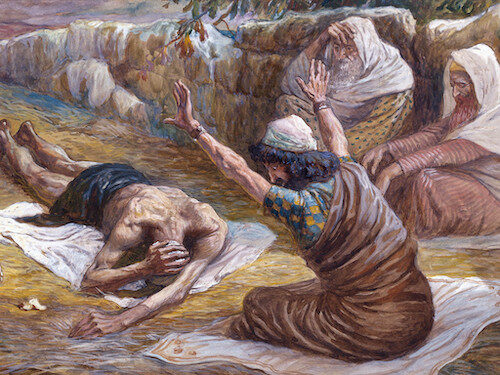
Today in the first reading, we hear of Job’s lamentaion. He spoke for all the good and the innocent who suffered for no apparent purposes. Had the story of Job had not a happy ending, his story would have been a total tragedy offering no hope in the Bible. Still it is a challenge for all Christians to defend the omnipotence of God together with His righteousness and mercy. Since ancient times, people have been criticizing the idea of an almighty and righteous Christian God who loves and cares for humanity. If this God were loving and caring, He would not have allowed the good and innocent to suffer. If this God were loving but were not able to deliver the good and innocent from sufferings, He would not be omnipotent! If He were all powerful but still allowed the good and innocent to suffer, not to mention the wicked had always been prosperous and healthy, this Christian God would not be fair and righteous! In short, Job’s story forces us to meditate on the mystery of sufferings, especially the sufferings of the good and innocent.

Some Christians put together passages from the Bible to prove that after all the good and innocent are not good and innocent as they appear to be. St. Paul says, “All have sinned and are deprived of the glory of God” (Romans 3:23). Therefore, goodness and innocence of people are actually superficial. They can only fool the eyes of human beings but not God’s. Moreover, God says, “You shall not bow down before them or serve them. For I, the Lord, your God, am a jealous God, bringing punishment for their parents’ wickness on the children of those who hate me, down to the third and fourth generation” (Deuteronomy 5:9). Who in his right mind would “hate” God? In the context of this piece of proof-text, the word “hate” means “love less” because the Hebrew language does not have comparative syntax. The text is a warning against idolatry. God will punish down to the third and fourth generation those people who love idols more than Him. Alas! Humanity loves making different sorts of idols such as power, wealth, knowledge and even health, to secure their livelihood! Therefore, sufferings are God’s punishments for your sins or sins of your ancestors etc. This argument is extremely weak and is refuted by Jesus when He cured the man born blind. Jesus says, “Neither he nor his parents sinned; it is so that the works of God might be made visible through him” (John 9:3). Jesus is Christ and His words do not apply to this blind man only but are applicable universally. In fact, prophets in the Old Testament also refute the view that children should suffer for the sins of their parents (Ezekiel 18:20-21). Though it is not easy to pin down exactly what Jesus means by “the works of God might be made visible through him [the born blind]”, the argument that sufferings are God’s punishments has been proven wrong by the Son of God!

Some Christians put forth the argument that sufferings are good for us. If our lives had always been a bed of roses, our potentials would have been buried/stored away (Matthew 25:18; Luke 19:20) and would not have had the opportunity to emerge and grow. For example, take a look at the athletes who undergo hellish trainings. Of course they suffer more than any other ordinary people. But it is a price to pay in order to attain good results and to defeat rivals. This argument gives sufferings a purpose and the victims a hope. Bear the pains and tomorrow will be a better day! Obviously this argument is insufficient. Take a look at people who suffer illnesses or poverty until their last breath. Just as what Job laments, “My days are swifter than a weaver’s shuttle; they come to an end without hope” (Job 7:6). When the better tomorrow keeps receding from you and the situation shows no signs of improvement, how unbearably heavy and hopeless a suffering life is!

Some Christians console themselves to argue that sufferings make us “wounded-healers” so that in the future, we may be more capable of helping those who undergo similar sufferings because we have gone through the pains and survived. Just as what St. Paul says in the second reading today, “To the weak I became weak, to win over the weak. I have become all things to all, to save at least some” (1 Corinthians 9:22). Indeed the Son of God did not save humanity in an aloft manner from heavens above, but took flesh to become man; lived among us to undergo human sufferings. “For we do not have a high priest who is unable to sympathize with our weaknesses, but one who has similarly been tested in every way, yet without sin” (Hebrews 4:15). This argument is reasonable as long as the wounded-healers do not fall into the trap of thinking themselves Saviours. Healing comes from God, not from us. Even genuine faith-healers/exorcists are merely channels of God’s grace. However, this argument still fails when the wounded-healer dies and does not have the opportunity to heal others!

Lastly, some Christians suggest that we should not be myopic but should look from God’s long-term perspective. God has a grand plan. Be patient and let God’s plan unfold. Then we’ll understand. This argument brings to mind the famous aphorism of Tertullian “The blood of the martyrs is the seed of the Church” (Apologeticus, L.13). In the spirit of the Parable of the Sower, sufferings of the good and the innocent are truly seeds of gospel messages which will touch the hearts of some people and the torch of God’s gospel will pass on! Though efficiency might not be high, as long as more of us generously respond to God’s call to become labourers, we are optimistic that the harvest will be abundant (Matthew 9:37b-38; Luke 10:2). Alas! We have been meditating God’s grand plan for two millenia but who has successfully scratched the surface of God’s grand plan? This seed metaphor has missed one crucial point. What makes the blood the seed? The Passion and Resurrection of Jesus Christ does! The Son of God is the True Pascal Lamb who takes away the sins of the world by bearing the brunt of all human evils. He retains the wounds after Resurrection to remind His followers that evils really hurt. St. Paul says, “Now I rejoice in my sufferings for your sake, and in my flesh I am filling up what is lacking in the afflictions of Christ on behalf of his body, which is the Church” (Colossians 1:24). St. Paul does not promise his readers a better tomorrow. Instead, he gives sufferings a new purpose, namely to take part in Christ’s effort to build the Kingdom of Heaven on earth!

What impresses me most in the gospel story today are the exorcisms. Though the exorcisms were mentioned in general terms (Mark 1:32, 34), together with the one mentioned in details on last Sunday, there are altogether three mentions in the first chapter of Mark. In New Testament times, Jews attributed sickness to either God’s punishment or demonic possession. Demonic possession was permitted by God as a punishment as well. Therefore, the sick bore all the blames and could not expect sympathy from fellow Jews. Following this logic, lepers and the possessed were typical sinners! Nowadays, thanks to Jesus’ exhortation on the Last Judgment, “Ill and you cared for me” (Matthew 25:36b), modern people treat the sick more humanely. Of course, there is still room for improvement because not all the sick are treated equally. Some are more equal than the others. Today, there are still many things we are ignorant about some illnesses, in particular mental illnesses. Ignorance breeds fears and prejudices. Therefore, mental patients do not receive the dignity due them. Even worse, totalitarian states lock up dissidents not only in correctional institutions but also mental institutions! I am concerned because the good and the innocent will easily fall prey to such injustice and sufferings.

Alas beloved brethren! Life is really a complex phenomenon. The case of totalitarianism points to the fact that it is unfair to put all the blame on God. Humanity has a share of blame to bear. Take a look at the global climate crisis today. The faults of some people make the rest victims. It follows that we should take up the responsibility to clean up the mess we create. In short, not only does Jesus heal, but we Christians are also sent out to heal the world as channels of the Father’s grace.
Heavenly Father! Deliver us from evil. Amen.


2021 Reflection
Picture Credit: valleyofsprings.com

Sunday, 31 December 2023

The Holy Family May Not Be Happy 聖家不一定快樂

Feast of the Holy Family, Year B
Theme: The Holy Family May Not Be Happy 聖家不一定快樂

All happy families are alike; each unhappy family is unhappy in its own way”, opens Anna Karenina a novel written by Leo Tolstoy. The statement speaks volume because by whatever standard, few families on earth can be happy. A Chinese aphorism says, “Be Contented, Be Happy”. To be candid, who on earth enjoys poverty, exploitation, sickness and betrayal etc.? Sometime, somewhere and somehow, bad things always happen to good people and few families are able to stand firm. From the news, we heard of the gradual heart failure of a 3-year old girl who fell into comatose as a result of medical blunders some 18 months ago. One of my ex-students, a successful businessman, has been struggling with his final stage of cancer for a number of years. All medical and para-medical procedures have been exhausted. He is expected to pass away soon, survived by his wife and 2 children in their teens! Again from the news, a few days ago a debt-ridden gambler attacked and attempted to murder his wife and two daughters before setting himself on fire! Some debtors end up imprisoned overseas when they try to repay debts as drug-mules. A post-graduate’s corpse was dumped after being found to show no vital signs because of ketamine overdose, smashing the hopes of his parents and perhaps dreams of his girlfriend. There are many divorce cases due to extra-marital affairs, leaving the children to pay the price … The cruelty lies in the fact that when one family member suffers, all other family members will suffer as well (1 Corinthians 12:26a). All of them become collateral damages! On one hand, we should be grateful for those bad things have not fallen upon us. However, my heart cannot ache more because I am no faith healer to save my ex-student or the 3-year old comatose girl. I am not able to raise the post-graduate from the dead and give him back to his parents like Christ did and I don’t have billions of dollars to pay off the debts of the inmates I visited etc. I have to accept the fact that I am in no position to play God but regrettably, close to my heart, Catholic families are not exempted!

Families have evolved from extended to nuclear, the former being appropriate for agricultural societies and the latter industrial. Now, humanity is moving away from industrial to informational in which we rely more and more on social media, virtual reality and artificial intelligence for communications and connections. If family and marriage have failed to be functional and successful social institutions in modern era, should they be modified or even better, be abolished? On the other hand, people still insist on the superiority of personal touches in communications and connections. They continue to defend the goods of familial and marital life against the onslaught and corrosion of all these new media! Which direction should we proceed?

As Catholics, we believe in the Father, the Creator of the known universe. He is not a remote and aloft deity but a Being actively getting Himself involved in our lives. He even sent His only begotten Son to die for us to redeem us! Archangel Gabriel says, “For nothing will be impossible for God” (Luke 1:37). Therefore, with a caring and omnipotent Father, Catholics should have no worries at all when they are following God’s way and doing God’s will in any adverse situation. Alas! Life on earth is anything but simple at all!

Firstly, few people know for sure the details of God’s will. Many biblical characters like Abraham the Patriarch, the Blessed Virgin Mary, her spouse St. Joseph and John the Baptist etc. did not show any understanding of God’s will. John the Baptist did not acknowledge his role as Elijah to appear before the coming of the Messiah (Malachi 3:23; John 1:21) though Jesus affirms that he is (Matthew 11:14). St. Joseph thought that divorcing the Blessed Virgin Mary quietly would do her good (1:19). An angel appeared to him in a dream to advise him otherwise (1:20). Mary intended to serve the Lord in the capacity of a virgin (Luke 1:34) and Abraham accepted Sarah’s proposal to father his descendants through Hagar (Genesis 16:2). Simply put, we don’t have the intelligence to fathom God’s plan. How right Isaiah is when he says, “For my thoughts are not your thoughts, nor are your ways my ways --- oracle of the Lord. For as the heavens are higher than the earth, so are my ways higher than your ways, my thoughts higher than your thoughts” (Isaiah 55:8-9)! We are back to square one, to the very first question at the beginning of this meditation. “Who on earth enjoys poverty, exploitation, sickness and betrayal etc.?” When God wants to bless us and sanctify us with poverty, exploitation, sickness and betrayals, the more we insist on our opinions, comfort and convenience, the stronger we are fighting against God’s will! The Blessed Virgin Mary has shown us how to deal with ignorance of God’s will. She “kept all these things … in her heart” (Luke 2:19, 51b). Instead of allowing ignorance to breed resistance, she keeps reflecting in her heart with humility on what she has seen.

The Holy Family was not living in a bed of roses. Mary and Joseph might have quarrelled a bit about the unexpected pregnancy before the angelic intervention. The census brought about the labour of the BVM to give birth to the Holy Infant in a manger in Bethlehem. The Magi brought precious gifts as well as murderous assault of Herod the Great, leading to the massacre of the Holy Innocents as collateral damages! The Holy Family needed to flee to a foreign land which previously enslaved them! St. Joseph probably died when Jesus was still a teenager. Today, we hear of Simeon’s prophecy about the future sufferings of the Blessed Virgin Mary (Luke 2:35a) who followed the Son of God up to the foot of the cross on Mount Calvary (John 19:26) … etc. Could the Holy Family be a happy one? Most likely not. But I am sure the Holy Infant would grant the Holy Family heavenly peace not as the world gives (14:27).

Pardon me for sounding pessimistic. Heavenly peace from the Holy Infant is intangible. Take a look at the “Holy Infant among rubble in Bethlehem” photo that goes viral on the Internet and you will agree with me. It is hard for me and for most people to accept bad things happening to innocent people like the civilians in Gaza today. You are free to blame me for being too short sighted and impatient to see the bigger picture. You can tell me that Jesus has taught us to be humble (Matthew 11:29) and obedient (26:39). Job has acknowledged God’s omnipotence and human ignorance (Job 42:2-3). But I cannot imagine how I am able to accompany women suffering from depression to reconcile with their cheating husbands or vice versa; to restrain compulsive gamblers to remember their spouses and children; to visit inmates sentenced to decades of imprisonment while my chaplain pass lasted for five years only etc. Perhaps it will take me a lifetime to sink Jesus’ and Job’s teachings into my psyche. By then, I wish I would be able to confess like Job, “I disown what I have said, and repent in dust and ashes” (42:6).

Year 2023 is ending in a few minutes. It has not been a pleasant year but it will definitely come to pass. May the Holy Infant bless us to stick together to weather through the turmoil ahead. Amen.
God bless!


2020 Reflection
Picture Credit: twitter.com/nour_odeh/

Sunday, 23 July 2023

Wake Up Calls 暮鼓晨鐘

Sixteenth Ordinary Sunday, Year A
Theme: Wake Up Calls 暮鼓晨鐘

When we return to Ordinary Sundays again after the Easter Season, we contemplate the teachings of Jesus Christ in details. In previous weeks, we meditated on Jesus’ giving the Twelve the authority to exorcise, to cure diseases and to proclaim the Kingdom of Heaven (Matthew 10:7-8). He also warned them beforehand of the obstacles and persecutions they would encounter during this evangelization mission which is the raison d’etre of the very existence of the People of God. The Church exists to proclaim the good news of reconciliation until the end of the age. Paul says, “Woe to me if I do not preach it (the gospel)” (1 Corinthians 9:16b). Now that we have the duty to preach it, we have the responsibility to know what the “Kingdom of Heaven” is. The concept of “kingdom” seems to be irrelevant in modern world where very few countries are likely to retain the institution of monarchy.

It is probably correct to say that kings should never have existed. In ancient times, gods were the emperors sitting on the heads of human beings. Nowadays most people don’t believe in gods but believe that all men are equal. It is not right for a single person or a minority of elites to enjoy more privileges than the rest. On the other hand, some kind of a leader will definitely arise when men live in a community. They need to work together to do big projects for the continual existence of the community. It is not wrong for the majority to give up some freedom and privileges so that the leaders to facilitate their service. Therefore, on a social level, leaders whether they are kings/queens, chairpersons, presidents, CEO’s or what not have to exist for the well-being of a group be they empires, republics and corporations etc. Therefore, in between those two ages, kings replaced gods to lead the commoners to fulfil their personal ambitions. Christians are not minorities in the world. We believe that God is the Creator of this known universe. Logically, He has sovereignty over and above everything imaginable. Therefore, the “Kingdom of Heaven” is relevant today and even the future as long as there are Christians on earth.

For at least three consecutive Sundays, the gospel readings focus on the “Kingdom of Heaven”. The concept of a kingdom as a social institution is already a complicated one, not to mention the “Kingdom of Heaven”. How do you convey the message to the crowd? Jesus chose to tell them in parables which are short stories about familiar things in our daily life: farming, fishing, salt, light, leaven, plants, pearls, sparrows and dogs etc. They are easy to understand and remember. Of course, we don’t expect those simple stories to be able to describe the concept completely. One parable may be able to describe one aspect of the Kingdom of Heaven only but together, they will be able to paint a more nearly complete picture of the whole. Thus, Jesus tells us many parables about the “Kingdom of Heaven”. He would explain some parables to the Twelve only. The “Weeds in the Field Parable” which we read today is one of them (Matthew 13:24-30, 37-43).

Incidentally, in the telling of this parable of “Weeds in the Field” Jesus also answers the perennial question why God allows evil to exist alongside the good. I’m sure all of us are familiar with the stories of Abraham sacrificing his only beloved son Isaac and what had happened to Job in the Old Testament. Though the Bible offers us happy endings in both cases, in real daily life, not all people are as lucky. Evils cause sufferings, pains and even deaths on a large scale. Their existence challenges our beliefs in a merciful, righteous and omnipotent God. Therefore, Jesus’ answer is worth meditating.

In the parable when the servants see the wheat and weeds grow up together, they suggest pulling the weeds up. The master replied, “No, if you pull up the weeds you might uproot the wheat along with them” (13:29). The Lord is actually saying, underneath the ground, the roots of wheat and the roots of weeds entangle with each other. Pulling one up would uproot the other as well. How should we understand this in our reality?
In our daily life, we do see wicked people and righteous people mingle together. We can only judge them by what we can observe on the outside, their words and deeds. However, deep within our hearts and souls, there is a humanity common to all, some essence that makes us human, not animals or robots. I think this humanity, this “image of God” (Genesis 1:26) is “the roots” the Lord refers to in the parable. When Adam and Eve disobeyed God, they lost the Original Graces which God gave them when they were first created. When those graces are depleted, the “image of God” began to deteriorate, some faster while others slower depending on the environment in which they live. Assuming that they start on the same footing, the righteous may be those who deteriorate slower but it is possible that they may turn bad. Similarly, the wicked may be those who deteriorate faster but we cannot deny the possibility that they may turn good. The prophet says, “When the just turn away from justice to do evil and die, on account of the evil they did they must die. But if the wicked turn from the wickedness they did and do what is right and just, they save their lives” (Ezekiel 18:26-27). It takes time for both the righteous and the wicked to prove themselves!

On the other hand, the existence of evil can also be a wakeup call! In the Beatitudes, Jesus teaches us to be mournful (Matthew 5:4). We mourn when we’re painful. Who on earth wants to endure pains. Alas! Prosperity has taken away our awareness of the importance of pains. Most people seek comfort as well as gratification and avoid pains and sorrows. How are pains essential for us?
First of all, pains remind us not to make the same mistakes that cause pains. We don’t need to make the mistakes ourselves. Seeing others suffer is enough to alert us of the issues. Of course, “Skin for skin” (Job 2:4), when pains touch our bones and flesh, our learning will be deep and long lasting! For example, how many of us mourn for the evil of “human trafficking”, especially youngsters? No we don’t because human trafficking is NOT happening in this city nowadays. How many of us feel the bites of food prices because supply chains are disrupted by the ongoing war between Russia and Ukraine? No we don’t because we can afford the prices! That’s a serious spiritual problem. Where has our righteousness gone? Our hearts are in the danger of hardening and becoming complacent!

Secondly, in our comfort zone, everything is under control. We can handle everything efficiently with minimum efforts. In this case, at least two dangers are waiting to ambush us. Since we are in control, we are in the danger of playing God ourselves. We simply don’t need a Saviour God anymore! This is the first danger. The second danger is burying our talents in the ground (Matthew 25:25)! Then a lot of our potentials remain dormant because we don’t need to conjure them up to deal with adversities while we are hiding and enjoying inside our comfort zone. In this case, we need God to break into our comfort zone. Let me assure you, it is going to be excruciating but healing at the same time. We need to conjure up our potentials to put up a fight against evil. We need to continue to do the right things. Going against the worldly current is surely painful but it makes us strong and unleashes our potentials.

Brethren! Let’s pray to our merciful Lord who has ventured into the fearful realm of sins and death to break a new path for us to follow; ask Him to grant us graces and allow us to follow His footsteps to conquer death! Amen!
God bless!


2020 Reflection
Picture Credit: orthochristian.com

Sunday, 25 June 2023

Our Love Is Not Perfect 我們愛得不圓滿

Twelfth Ordinary Sunday, Year A
Theme: Our Love Is Not Perfect 我們愛得不圓滿

Though the truth will set us free (John 8:32), speaking the truth may make the speaker unpopular and even a martyr! Today’s gospel picks up where we left off last week but skips a few crucial verses. Last week, we read of how Jesus Christ gave the Twelve authority over unclean spirits to drive them out and to heal all sorts of diseases (Matthew 10:1). Then He sent them off proclaiming the coming of the Kingdom of Heaven (10:7). If the Twelve were sent by the Lord to proclaim messages, they (the messages as well as the messengers) were expected to be received without opposition. However, life is rather complicated. For various reasons, many people reject the truth and powerful people may even kill the messengers! Such is the reality of life! Before the gospel reading today, there are eleven verses of warnings about the difficulties and persecutions awaiting the Twelve and all evangelists in the future!

To begin with, Jesus says, “Behold, I am sending you like sheep in the midst of wolves; so be shrewd as serpents and simple as doves” (10:16). “Sheep in the midst of wolves” is not a bloody image but rather an eschatological and positive image. It describes the Messianic age in which “The wolf shall be a guest of the lamb, and the leopard shall lie down with the young goat” (Isaiah 11:6). Therefore, the apostles were messengers of the coming of the Messianic age. But before the actualization of the Messianic age, the messengers will encounter difficulties and persecutions because they will crash head on against established institutions! That is why they must remain shrewd as serpents but simple as doves!

Men live in communities. They develop traditions and institutions to facilitate smooth interactions among individuals. However, those customs, traditions and institutions might not follow and even go against the will of God! For example, abortion, polygamy and slavery. Power institutions are supposed to serve the people but legal experts who know the technicalities of the rules will be able to embezzle without being caught! Thus, God’s messengers will be persecuted in courts and synagogues by governors and kings (Matthew 10:17-18). To contain damages even family members and friends have to severe their ties (10:21) with messengers of the truth. How deplorable a world we are living in! Then, we come to the three “Be Not Afraid” sayings in today’s gospel.

Therefore do not be afraid of them” (10:26a). From the context, Jesus is referring to the secular authorities. Do not be afraid of kings and governors because they are powerful people and even usurpers of God but they are not God after all. Jesus elaborates further, “And do not be afraid of those who kill the body but cannot kill the soul” (10:28a). Now, we know why we don’t have to be afraid of them because they are mere mortals and they cannot kill the soul which is the image of God. Who then can kill the soul? Obviously it must be God. Who else? Can Satan or its demons? From the example of Job, we see that without God’s permission, even Satan can’t do harm on a man (Job 1:12), nor his life (2:6). So, we should fear only the Lord who is able to put our soul to death, though He does not want to! He desires rather that sinners “turn from their evil way and live” (Ezekiel 18:23).

The story of Jeremiah is a depressing one. God told Jeremiah the fate of Judah, “Your own eyes shall see them fall by the sword of their enemies. All Judah I will hand over to the power of the king of Babylon, who shall take them captive to Babylon or strike them down with the sword” (Jeremiah 20:4). It is the most unpalatable message one can deliver to one’s own country. You will be accused of sedition; become a public enemy and be put to death! Who in his right mind does not reject such a message? Jeremiah was in a dilemma, “All day long I am an object of laughter; everyone mocks me … The word of the Lord has brought me reproach and derision all day long. I say I will not mention Him, I will no longer speak in His name. But then it is as if fire is burning in my heart, imprisoned in my bones; I grow weary holding back, I cannot!” (20:7-9) Jeremiah is truly an authentic spokesman of God. Unlike false prophets who speak on behalf of God to please the audience so as to save their own skins, Jeremiah speaks the truth at the expense of his own life. Consequently, even his friends denounced him and watched for any misstep of his (20:10). Jeremiah had full confidence in the Lord to take vengeance on his enemies (20:12) but in the end, he was murdered. Don’t expect swift vengeance from God. Remember, the Lord is patient and He desires the wicked to repent and live (Ezekiel 18:23)!

You might feel being unfairly treated. Why should we Christians be scapegoats? Why should we suffer and be taken advantages of? Jesus’ word is our only support. He says, “You will be hated by all because of my name, but whoever endures to the end will be saved” (Matthew 10:22). Jesus assures us that the Father is in full control because “Not one of them [sparrows] falls to the ground without your Father’s knowledge. Even all the hairs of your head are counted” (10:29b-30). You may find counting hair useless and trivial. Yet, it reveals how far and minute God’s love can go. “So, do not be afraid; you are worth more than many sparrows” (10:31). God cares about us, in particular, the well-being of our souls. He will go to any length to ensure that we will be saved and thus, we should not be afraid in speaking the truth and proclaiming the Kingdom of Heaven.

John’s meditation sheds light on fear from another angle. He says, “There is no fear in love, but perfect love drives out fear because fear has to do with punishment, and so one who fears is not yet perfect in love” (1 John 4:18). Here, John uses the word ἀγάπη, to love for the good of the loved ones. Incidentally, it removes my worry about Simon Peter because Jesus Christ says, “But whoever denies me before others, I will deny before my heavenly Father” (Matthew 10:33). Simon Peter immediately comes to mind. Luckily, the gospel of John recorded an incident in which Jesus Christ asks Peter three times whether he loved Him (John 21:15-17). For the first two times, Jesus uses ἀγάπη but Peter could only respond with φιλέω, to befriend. I suppose the Master-Disciple relationship has prevented Peter as well as all of us from loving the Lord more intimately. Jesus understands and doesn’t want to impose His will on us. So when He asked the third time, He uses φιλέω for the good of Peter. I suppose we don’t have to worry about the fate of Simon Peter any more. His position is secure.

Brethren! How much do we love God? Do we love as much as Jeremiah? Or as much as the Psalter who says, “Because zeal for your house has consumed me, I am scorned by those who scorn you” (Psalms 69:10). When the love of God is strong enough, we’ll have no fear. Moreover, how much do we love our family members, our neighbourhood, our society and even our country? Do we care about the fate of our family members and friends, colleagues and comrades, even our president and king? When our love for them and for their fate is strong enough, we’ll have no fear. Then we’ll be able to speak the truth without worry. Our hearts will be in peace. Amen.
2020 Reflection
Picture Credit: the1foundationdotcom

Sunday, 14 May 2023

Come Holy Spirit 聖神請來

Sixth Easter Sunday, Year A
Theme: Come Holy Spirit 聖神請來

The Easter Season will end on the Pentecost and we are approaching it. Thus the Holy Spirit becomes the major theme of the Sunday readings during these few weeks. In the first reading today we see the continuous growth of the early Church under the guidance of the Holy Spirit and in the gospel, we read of Jesus pledging to ask the Father to send the Holy Spirit to the disciples as another Advocate (John 14:16).

The Church celebrates the Descent of the Holy Spirit on the Pentecost as her birthday. The beginning of the early Church in Jerusalem was exclusively Jewish. However, there was a subtle division: Hebrew-speaking Jews vs. Greek-speaking Jews. This subtle division became an issue when the Greek-speaking Jews started complaining that “their widows were being neglected in the daily distribution” (Acts 6:1). It is inevitable because the bigger the size of a community, the greater its complexity. A new institution of deacons was set up within the growing Church to handle this complexity.

A lot of things had happened before the first reading today. St. Stephen, one of the seven elected Greek-speaking deacons was stoned to death because of his eloquent preaching. He became the first Christian martyr. The Sanhedrin began purging the Christian community. Thus most of her members fled Jerusalem and only the apostles remained (8:1). Today, we read of the evangelization work of deacon Philip in Samaria and we see a further development of the Church, namely the apostles have the faculty to lay their hands on the baptized to give them the Holy Spirit (8:17). This is significant for two reasons. Firstly, the apostles were the foundation of the hierarchy of the Church. All further division of labour/ministries within the Church originated from the apostles and their successors. More significantly, they reserve the faculty to give the Holy Spirit to themselves. Deacon Philip preached, worked miracles and baptized only. He could not give the Holy Spirit. Secondly, John says, “The wind blows where it wills, and you can hear the sound it makes, but you do not know where it comes from or where it goes” (John 3:8). Which means human beings are not supposed to manipulate the Holy Spirit. We cannot appease the Holy Spirit by offering sacrifice to Him! However, here in Samaria for the first time in history, the Holy Spirit could be invoked and would follow the will of an elected few, namely the apostles! The Church in modern times has come a long way to arrive at the present form. Yet, the legitimate successors to the apostles remain the foundation of the Church for all ages.

In the gospel reading today, Jesus continues His farewell discourses. Earlier on Jesus gave the disciples a new commandment, “I give you a new commandment: love one another. As I have loved you, so you also should love one another” (13:34) That’s the only commandment we have in record. But today Jesus says, “If you love me, you will keep my commandments” (14:15). “Commandment” is in plural which is not apparent in case-insensible languages such as Chinese! One may wonder what other commandments are included “my commandments” besides the “Love one another as I have loved you”. Perhaps we have forgotten that Jesus is God. He says, “Do not think that I have come to abolish the law or the prophets. I have come not to abolish but to fulfil” (Matthew 5:17). The Ten Commandments were also given by the Son of God! Therefore, when Jesus used the plural form of the word “commandment” in “my commandments”, He was declaring His divinity as well.

Further down, Jesus says, “And I will ask the Father, and He will give you another Advocate to be with you always” (John 14:16). If the Holy Spirit is “another Advocate”, who is the Advocate in the first place? Of course it is Jesus Himself. We can find the clues in several places. “My children, I am writing this to you so that you may not commit sin. But if anyone does sin, we have an Advocate with the Father, Jesus Christ the righteous one” (1 John 2:1). “He, because he remains forever, has a priesthood that does not pass away. Therefore, He is always able to save those who approach God through Him, since He lives forever to make intercession for them” (Hebrews 7:24-25). “Who will bring a charge against God’s chosen ones? It is God who acquits us. Who will condemn? It is Christ Jesus who died, rather, was raised, who also is at the right hand of God, who indeed intercedes for us” (Romans 8:33-34). Why do we need a perpetual Advocate? It is because there is “an Accuser of our brothers … who accuses them before our God day and night” (Revelation 12:10). This Accuser is Satan who is allowed audience in God’s presence (Job 1:6) before “it is thrown into the pool of fire and sulphur” (Revelation 20:10) at the Last Judgment.

So, while Jesus Christ intercedes for us at the right hand of the Father, the Holy Spirit accompanies us in our perilous journey on earth. The Holy Spirit is the Spirit of Truth and it remains with us and in us (John 14:17). The “Spirit of Truth” is just another way of saying the “Spirit of Jesus” because earlier on Jesus describes Himself as “The Way and the Truth and the Life” when He proclaims His divinity (14:6). Incarnation confines the Son of God to a well-defined point in space and time. Now that Jesus would ascend into heaven and remains there to intercede for us, the Holy Spirit takes over the Son’s salvific mission but with a greater freedom in space and time on earth. Yet earlier, Jesus says, “If you remain in my word, you will truly be my disciples, and you will know the truth, and the truth will set you free” (8:31-32). The mission of the Son is to redeem and to save. Thus, the Holy Spirit continues to set us free from the bondage of sins by residing in us. If you have any doubt about the possibility of Holy Spirit’s residence in our sinful bodies, let’s listen to what the apostle says. St. Paul puts it concretely when he preached against prostitution. “Do you not know that your body is a Temple of the Holy Spirit within you, whom you have from God, and that you are not your own?” (1 Corinthians 6:19).

The Holy Spirit is essential for us in leading our spiritual life. In His revelation to the Samaritan woman, Jesus teaches, “God is Spirit, and those who worship Him must worship in Spirit and truth” (John 4:24). This is a Trinity formula we must adhere to when we worship God. Thus, our prayers, devotions, liturgy and sacramental must be conducted within the context of the Blessed Trinity without which all acts of devotion would be in vain. The role of the Holy Spirit as an Advocate is best expressed by St. Paul who says, “The Spirit too comes to the aid of our weakness; for we do not know how to pray as we ought, but the Spirit itself intercedes with inexpressible groanings … because it intercedes for the holy ones according to God’s will” (Romans 8:26-27).

Brethren! It is understandable that most of us are not familiar with the Holy Spirit. Unlike Jesus Christ whom the disciples might see, hear and touch, the Holy Spirit is not tangible. Don’t worry. The Holy Spirit is within us and comes to our aids with inexpressible groanings. Though we are not bishops with the faculty to give the Holy Spirit, He will prompt us to invoke Him to our aids. Amen.
God bless!

2020 Reflection
Picture Credit: flickr.com

Sunday, 9 April 2023

Have You Mourned Before Easter? 復活節前你哀慟了嗎?

Easter Sunday, Year A
Theme: Have You Mourned Before Easter? 復活節前你哀慟了嗎?

The Church assigns forty days for the elected to prepare themselves for their baptisms. This is called the Lenten Season which those who were already baptized also have to make use of. Instead of preparing for baptism, the baptized do the same things the elected do to renew their spiritual life. So, the whole Church prays, fasts/abstains and gives alms to the needy particularly in Lent. With these traditional practices and pieties, such as Stations of the Cross and retreats, the elected examine their decisions to follow Jesus while the baptized attempt to rebuild their relationships with their Saviour. Easter is supposed to be a joyful season for all Christians, in particular the newly baptized. Through baptism, the elected becomes a Christian and a new creation (2 Corinthians 5:17). He is leading a new way of life in the spirit of the Beatitudes. He’ll find support in a community of redeemed people served by ordained ministers! Through prayers, bible studies, sacraments and charity services etc., he’ll build up an enriching relationship with Jesus Christ and is infused with His saving graces …

Alas! We’re living in a world contaminated by sins. In fact it is easier getting “dirty/old” than keeping “immaculate/new” in such an environment! If joyfulness is a measure of the possession of this newness, I’m afraid many a Christian would have difficulty to be joyful in Easter as he matures gradually and surely! We cannot simply brush this feeling of “a lack of joy” aside as something inessential because among the nine fruits of the Holy Spirit, “joy” occupies the second position (Galatians 5:22)! Put yourselves in the shoes of Christians in Ukraine. Are you able to find joy when you are shrouded in the cloud of a war which has been dragging on for over a year and its end is controlled not by you but by the super powers in the world? Or one of my friends whose son died of tooth cancer after several years of agony! Don’t tell me it is a test of the faith of the people concerned. This interpretation might be correct in that latter case but it is insensible. Applying such an interpretation in wars is simply wrong! If it is not a matter of faith, where else can we turn?

The word of the father in the Parable of the Prodigal Son came to mind, “But now we must celebrate and rejoice, because your brother was dead and has come to life again; he was lost and has been found” (Luke 15:32) Thus, the joy of Easter is one of finding the lost and resurrecting the dead! Then we need to examine how much we are lost/dead in the previous year before this Easter. How much have we mourned and grieved for our loss/death?
On Good Fridays, we mourned and grieved for the Passion of Christ on the cross, in particular His being pierced. The Son of God came to fulfil the prophecy of the prophets (Matthew 5:17), this time Zechariah who says, “When the inhabitants of Jerusalem look on him whom they have thrust through, they will mourn for him as one mourns for an only child, and they will grieve for him as one grieves over a firstborn” (Zechariah 12:10). Jesus Christ is the Son of God. Jerusalem symbolizes the Kingdom of Heaven. Her inhabitants symbolize the People of God on earth today. On Good Fridays, the Church mourns and grieves for the Passion of Jesus Christ, but NOT as an only child or firstborn because Christ is head of the Church, the husband of the Bride! Only God the Father would mourn for Jesus Christ as the only Son and grieve for Him as a firstborn. Thus, in a miraculous way, God the Father mourns for His only begotten Son through the Church in our annual Good Friday liturgy! A more appropriate candidate comes to mind --- my friend whose son died of tooth cancer. He and his wife definitely mourned and grieved for their firstborn. The day on which they saw their son die must have embodied in their life the very first Good Friday in history. They must have their full share of mourning and grieving. Where would their joy come?
The words of Martha came to mind, “I know he will rise, in the resurrection on the last day” (John 11:24). That means my friend’s joy would arrive only on the last day. In the meantime, will he continue to mourn and to grief like someone with no faith? Or the Holy Spirit would console him in a mysterious manner!

A song came to mind. It is very soothing and expresses deep faith in the resurrection of Jesus Christ. The lyrics is drawn from the book of Job, “For I know that my redeemer liveth, and that he shall stand at the latter day upon the earth: And though after my skin worms destroy this body, yet in my flesh shall I see God” (Job 19:25-26, KJV). I hope you enjoy this song like most of us do.

This song is surely a dose of ointment that lightens my friend’s pain but only for a while. It is unable to bring back his son whom the cancer has destroyed. To a certain extent, the cancer has also bitten away part of his being. While he mourns the loss of his son on Good Friday, I pray that he is able to see that the Lord is actually carrying the cross of his son, taking upon Himself the tooth cancer of his son so that in the end my friend’s son might live. I also pray that the Lord’s sacrifice is able to fill the void created in him by the death of his son. I genuinely trust in the merciful Lord for carrying our burdens because He says, “Whatever you did for one of these least brothers of mine, you did for me” (Matthew 25:40). On one level, the Lord instructs us to serve the marginalized and the needy in our society. On another level, the Lord pledges to stand by the victims and sufferers and to lighten their burden just like what Simon the Cyrenian had done to Him (26:32). This is what we celebrate on Sundays, His resurrection. St. Paul teaches us that “Christ died and came to life so that He might be Lord of both the dead and the living” (Romans 14:9). He has risen to honour all His pledges to us, His Bride. Amen.

Brethren! Have you lost anything in previous year or before? Have you suffered frustrations and pains? Surrender and allow the merciful Lord to embrace you with His eternal bliss. Amen.
God bless!


2020 Reflection

Sunday, 1 January 2023

To Meditate the Mercy of God With Hearts 用心默想天主的慈悲

Solemnity of the BVM, Mother of God, Year A
Theme: To Meditate the Mercy of God With Hearts 用心默想天主的慈悲

The more we meditate upon the events happening to the Blessed Virgin Mary, the more we’ll be able to see the mercy of God. Usually, we expect life to become easy once we trust in the Lord. Why not? We’re doing God’s will. Shouldn’t all obstacles and troubles be cleared and wiped away before us? It only proves that we are not hardworking enough studying the gospels and don’t know the Lord’s teachings thoroughly enough so that we harbour such unrealistic misconceptions about the Lord, our God! Doesn’t He say, “Blessed are they who are persecuted for the sake of righteousness, for theirs is the kingdom of heaven” (Matthew 5:10) and “Whoever wishes to come after me must deny himself, take up his cross, and follow me” (16:24) etc.? How can we expect ours to be a bed of roses when the Holy Infant made a manger His crib?

Today, we celebrate the Solemnity of Blessed Virgin Mary, the Mother of God. Catholics believe that the virginity of the BVM is perpetual. That is to say, the BVM was a virgin before, during and after giving birth! Some people find it mind-boggling because a “virgin mother” is a contradiction. How can a mother be forever a virgin? Regrettably, some Christians have given up this ancient dogma. Similarly, some other people find it another contradiction to call the BVM, the Mother of God. They would rather call her the Mother of Christ only, because God is eternal. If God had a mother, thus an origin, thus some person existing before Him, then this deity would not be God as we understand it! Once again, it was an ancient heresy which had been settled. Bishops and Church Fathers at the Council of Ephesus (A.D. 431) saw this as an indirect attack on the unity of the divinity and humanity of Jesus Christ. This heresy would create two persons, one divine and one human, of Jesus Christ and the BVM could only be the mother of the human part of Jesus Christ because she is only a creature. In fact, those Marian dogmas remind us of the limitations of human reasoning. The mystery of God remains and the BVM has set us an exemplar, “And Mary kept all these things, reflecting on them in her heart” (Luke 2:19). So, let us make more use of our hearts than our brains for our meditations.

The Christian God is three-in-one and He is love (1 John 4:8). In other words, our God is a community of love and this love is not narcissistic. When love is outgoing, it generates life and wonders. The wonderful universe, which seems to be specifically designed to be suitable for human existence, exists because God is love and God loves His Creation, in particular human beings in a motive beyond our understanding. Genesis tells us that God created men in His own image (Genesis 1:26). In other words, we are the masterpieces of God’s Creation, showing off His glory. Yet, reality is cruel. In religious jargon, “all have sinned and are deprived of the glory of God” (Romans 3:23). Reality is cruel. In physical jargon, there are all sorts of corruptions, exploitations, pollutions, trafficking and wars etc. God’s images are abused, defaced, enslaved and twisted. In frustration, God would have been angry and would completely wipe us out of existence. Whether He would rebuild His project like an artist is none of our business! But He hadn’t. We find an enigma in the Bible, “I will put enmity between you and the woman, and between your offspring and hers. They will strike at your head, while you strike at their heel” (Genesis 3:15) and human history began to unfold as the Salvation History, starting with the story of Noah, then Abraham, Jacob, Joseph, Moses, Joshua, Gideon, David and Solomon etc. How blessed we are because God does not give us up. But so far, the enigmatic woman remains unknown.

Among the Judges, there was Deborah the prophetess who delivered the Israelites from the hands of their neighbouring enemies (Judges 4-5). But Deborah was not the enigmatic woman. Judith, a beautiful and rich widow, beheaded the commander of army invading Judah (Judith 13-14) and yet this heroic Judith was not the enigmatic woman. Esther the Jewish Persian queen saved the Jews from the murderous plan of Haman (Esther 5-8) and yet Esther was not the enigmatic woman. Not until the New Testament was the identity of this enigmatic woman revealed and she turned out to be a young virgin betrothed to a carpenter in Nazareth!
The Ancient Serpent would surely take a proactive approach and took the initiative to disqualify many promising candidates previously, men and women alike. Truly, the Devil seems to have gained an upper hand so far. When we go through the lists of liberators in the Bible, none of them were flawless. Either they had questionable personalities or they had made some less than desirable choices in their lives. Not only is God’s mercy beyond our understanding, but is probably also beyond the Devils’ understanding too. In the story of Job, Satan was also allowed an audience with God (Job 1:6)! Remember, Satan knows God better than we do. It has greater confidence in God’s mercy than we do. So, Satan does not suspect what God has been preparing.

With special graces, God prepares a virgin who was conceived without Original Sin. Satan did not bother because it was confident that somehow, this virgin would get married. Her husband would know her and she would give birth to a son to pass on the Origin Sin of the husband etc. Gabriel’s annunciation would not be a secret to Satan. Here, probably Satan has underestimated this “Son of the Most High, and the Lord God will give him the throne of David his father” (Luke 1:32). Well, even David committed adultery and murder while Solomon allowed idols to be erected in the Temple! In its pride, Satan would deem this Son of the Most High just another imperial idiot. Of course, it would not spare Jesus and put Him through tests to weaken His trust in the Father. It never occurs to Satan that the Lord God decides not only to redeem us, but also to adopt us as His children! How would God prefer an inferior creature to angels! Yet, God does! How did God accomplish this finesse? The second reading today tells it. “God sent his Son, born of a woman, born under the law, to ransom those under the law, so that we might receive adoption … So you are no longer a slave but a child, and if a child then also an heir, through God” (Galatians 4:4-5, 7) God cannot be dishonest. Satan as well as the heretics of subsequent generations are victims of other own pride!

How can the Son of God retain His divinity and eternity when He was born of the BVM, became flesh and made His dwelling among us (John 1:14)? Well, allow me to suspend my rationality to quote Gabriel, “for nothing will be impossible for God” (Luke 1:37). Furthermore, let’s see how God’s mercy is able to make the Ancient Serpent repent. Amen!
2017 Reflection
Picture Credit: mycatholic.life

Sunday, 7 February 2021

受苦的奧秘 The Mystery of Suffering

常年期第五主日,乙年
主題:受苦的奧秘

社會上的醫院制度,把資源集中起來運用,無疑對病人的康復,發揮了重大的作用;並且把病人與健康的人分隔,減低了疾病在社區擴散的機會,保障了公共衛生。但另一方面,亦引發出不少倫理的難題。醫院制度使醫學更昌明,很少人自然地去世,而是在藥物及機器的支撐下,度過不必要的痛苦歲月纔離世;對於何時停止醫治,親人要作出沉重的倫理抉擇…在香港,很少人在家中、在家人陪同的境況下離世,而是在醫院。死亡不再是日常生活的經歷,成年人為了「保護」兒童及青少年,不會讓他們接觸到死亡的「真面目」,反而令他們不懂生命的真正價值!在古代是兒童的夭折率高,現代卻是青少年的自殺率高!

今天福音一句不經意的話,道出古今醫療的差別。「到了晚上,日落之後,人把所有患病的和附魔的,都帶到他跟前。」(谷1:32)
首先,看病不是在日間更好嗎?為甚麼要在「日落之後」呢?
從上文可知,這一天正值安息日,不准做不必要的事。日落之後是新一天的開始,不再受安息日限制!固然,耶穌基督是安息日之主(2:28),安息日不能約束祂。這是後話,但猶太人遵守梅瑟法律的嚴謹態度,不會隨意走捷徑,可見一斑!
值得注意的,是耶穌基督也沒有走捷徑!祂「不許魔鬼說話,因為魔鬼認識祂」(1:34)。很多人信服魔鬼的說話,牠們的「見證」,應該很有說服力,令更多人信奉耶穌。但耶穌基督拒絕了這種方便,因為魔鬼的證言,祇會混淆視聽,令真理變得模稜兩可,反為不妙。

馬爾谷接著說:「人把所有患病的和附魔的…」,在沒有醫院把病人集中在一起的情況下,在甚麼地方纔找到病人呢?一定是在家中。他們在家人陪伴下來到耶穌跟前求醫,與今天的情況,沒有太大的分別。但值得注意的,是連附魔的,或者精神病的,也是來自家中。到了今天,這是沒有可能的。家庭被視為生產力的來源地,在資本主義制度下,保護家庭,減少疾病,包括精神病對家庭、對社會整體生產力的傷害,變得非常重要。家庭成員之間的關係和認識生命的價值,渴望天主的愛,變得次要!由此產生的社會問題不是問題,反而製造了更多的就業機會…,今天的社會,真的患病了!

說「所有」是否誇張了一點呢?是的,這是《馬爾谷福音》的文學手法,旨在說明耶穌基督是天主子,祂以大能施展救贖。所以馬爾谷選擇了驅魔,作為第一個神蹟。
耶穌基督不是以十字架上的犧牲、以服從及屈辱,最後從死中復活,完成救贖嗎?馬爾谷豈不是放錯了重點嗎?不一定。馬爾谷祇是描述了救贖光榮的一面,但光榮不是惟一的一面。要知道我們在真理面前,有點像瞎子摸象一樣,並不全面,頂多祇能領會其中一二。因此我們必須謙遜,尋求天主聖神的帶領。
事實上,沒有可能是「所有」患病或附魔的人,都有機會來到耶穌基督面前,接受醫治。因為有些病人,是被排斥在城外的,例如癩病人(1:40),有些附魔的人是不能制服的,例如「軍旅」(5:9)。這兩個例子讓我們看到,一旦社會上出現了歧視現象,即使是完美的醫療制度,也祇能把這些「病人」關進精神病院或監獄裡,而不能真正地照顧這些被歧視的人!

比較這段福音的其中兩句說話,讓我們不得不再次反省受苦的意義。「耶穌治好了許多患各種病症的人」(1:34)『許多』一辭與前面的『所有』(1:32)一辭相比,即使是修辭的手法,不是默認有部份人得不到耶穌的治癒嗎?耶穌基督不是全能而且慈悲的嗎?為甚麼竟漏了一部份人呢?
上述被歧視,被排斥的人和接近不了耶穌基督的人,我們不用替他們擔心,因為耶穌基督是善牧,祂一定會主動尋找他們,治療他們。撇除那些寧可躲在安樂窩而不願意痊癒的病人,這類人相信連神醫亦束手無策!他們的心腸已經硬化,有待耶穌基督特別照顧他們。讓我們集中默想那些希望痊癒,並且不斷祈求天主救助的病人,那些求天主醫治,消除痛苦的人。結果,他們的信德,並沒有帶給他們所渴望的救恩!換句話說,既然我們已經信主,為甚麼痛苦依然揮之不去呢?

腦退化晚期的病患者或者植物人,倘若不是醫學昌明,他們早已離世。今天醫療系統發達,他們可以靠喉管餵食餵藥,生存下來。他們整天臥床,動彈不得,靠護理人員替他們清潔,兼且失去了與外界溝通的能力,他們的生活質素很低。生存下去,在財務上及情緒上,帶給家人很大的負擔。痛苦下去還有甚麼價值呢?「安樂死」的念頭,真是一個極大的挑戰!

「受苦」真是一個奧秘,一個千百年來解決不了的謎題。很多人從約伯的故事,得到鼓舞,但他的故事不能說服所有的人,他的際遇不會發生在所有人的身上。他有一個大團圓的結局,但大部份人卻是懷著疑問和控訴,含恨而終。莫非我們真的不應該提問「為甚麼」嗎?或者我們問錯了題目嗎?我不服氣,因為我還未到達「是我以無智的話,使祢的計劃模糊不明;是我說了無知的話,說了那些超越我智力的話。」(約42:3)的境界。不過,最少我知道為甚麼進食前,我應該感恩唸經,因為我還未到達使用喉管餵食的地步;我感謝我的過錯,因為它們提醒我,應該做個謙卑的人;我不介意失敗挫折帶給我痛苦,因為它磨練我成為更堅強的人;我不奢望自己的痛苦,有助身邊的人親近天主,或者補贖他們部份的罪過,我祇願在餘下的歲月,能目睹天父的慈愛,並能開口讚頌祂,亞孟。
天主保祐!

家慈辭世之翌日

2018年講道
圖片鳴謝:wikipedia


Fifth Ordinary Sunday, Year B
Theme: The Mystery of Suffering

A medical system in a society centralizes medical resources. Undoubtedly, it plays an important role in the recovery of patients. Furthermore, separating patients from healthy people minimizes the spread of diseases in the community and enhances public health. On the other hand, it also engenders many ethical dilemmas. A medical system advances medical sciences. Consequently, less people die naturally. Relying on the support of medicines and machines, many people suffer months and years of unnecessary pains before they pass away. The decision to terminate medical treatment becomes a heavy moral burden on family members … In Hong Kong, few people die at home in the company of family members. Instead many pass away in hospitals. Death is no longer a daily experience. In the name of juvenile protection, adults seldom expose children and teenagers to the genuine face of death. As a result, it deprives them of an understanding of the true meaning of life! In ancient times, infant mortality was high. In modern times, it is the suicide rate of teenagers!

One verse in the gospel passage today inadvertently highlights the contrast of ancient and modern medicines. “When it was evening, after sunset, they brought to him all who were ill or possessed by demons” (Mark 1:32)
First of all, wasn’t it better to consult physicians during daytime? Why did it after sunset?
From the context, it was Sabbath on which people were forbidden to labour unnecessarily. After sunset, a new day began and Sabbath restrictions no longer applied. Of course, Jesus Christ “is Lord even of the Sabbath” (2:28). Sabbath is unable to restrict Him. That’s another story. However, Jews were meticulous in observing Mosaic laws. They didn’t take shortcuts!
Neither did Jesus take shortcuts! He was “not permitting them (demons) to speak because they knew him” (1:34). Many people believe in the word of demons. Demon’s “testimony” is persuasive and would make many people believe in Jesus. But Jesus Christ refused this convenience because the demons’ testimony would blur the truth, making it ambiguous. It is even worse.

Mark continues, “They brought to him all who were ill or possessed …” Without hospitals to put all the patients together, where did we find the patients? At home! Family members accompanied the sick to seek Jesus’ cure. It didn’t differ much from today’s situation. But I would like to draw your attention to the fact that even the possessed, or mental patients came from home! It is impossible today. Families are the source of labour. Under capitalism, protecting families, reducing the harms done to families and societal productivity through illnesses, including mental illnesses is of primary importance. Relations among family members, knowledge of the value of life and the desire for God’s love become secondary! Social problems created are no problem at all. Rather, they create more employment opportunities … Our society today is really sick!

Is the word “all” a bit exaggerating? Yes. This is the style of Mark which aims at portraying Jesus Christ to be the Son of God who redeems us with great might. Thus exorcism is the first miracle in Mark’s gospel.
Didn’t Jesus Christ sacrifice Himself on the cross, undergo obedience and humiliation and finally His resurrection from the dead accomplishes salvation? Has Mark struck the wrong chord? Not necessarily. Mark only tells the glorious side of redemption but glory isn’t the only side. In front of the truth, we are like the blind feeling an elephant. It is impossible to be complete. At most, we are able to understand one to two details. Thus, we must be humble and seek guidance from the Holy Spirit.
In reality, it is impossible for “all” who were ill or possessed to be able to gain access to Jesus Christ to seek cure. It is because there were sick people segregated outside the city such as lepers (1:40) and there were uncontrollable possessed men such as the Legion (5:9). These two examples remind us that once prejudice appears in a society, no matter how impeccable the medical system is, these patients could only be rounded up and locked up in mental hospitals or prisons. That doesn’t do these discriminated folks any good!

Comparing two verses in the passage, we are forced to reflect on the meaning of suffering. “He cured many who were sick with various diseases ...” (1:34) Contrasting “many” with “all” (1:32), even if it is a rhetorical device, doesn’t it suggest that Jesus hasn’t cured some people? Isn’t Jesus Christ almighty and merciful? Why did he leave out some people?
We don’t have to worry about those who have been discriminated and could not gain access to Jesus Christ who is the Good Shepherd. He definitely would reach out to seek and cure them. Remove from our short list those who prefer hiding inside their comfort zone and are reluctant to be cured. Even miracle healers wouldn’t be able to heal them. Their hearts are hardened and need special treatment from Jesus Christ. Let us focus on those who hope for recovery and ceaselessly seek God’s help, those who beg God to cure them and relieve them of pains. In the end, their faith does not bring them the salvation they desire! In other words, we believe in God. Why do pains linger on and refuse to disappear?
Comatose and Alzheimer patients in the terminal stage would have died had medical sciences not been that successful. The medical system today is advanced. Those patients manage to survive through tube feeding of nutrients and medicines. They’re bedridden, motionless and rely on care-takers to cleanse them. They have even lost the ability to communicate. Their quality of life is extremely low. Keeping them alive is financially and emotionally straining to family members. What’s the point of continuing to suffer? The idea of euthanasia is a big challenge!

Suffering is truly a mystery, a hard enigma to crack for millennia. Many people draw inspiration from the story of Job but not all of us buy his message. His encounters do not happen to us all. His was a happy ending, but most people die questioning and complaining. Is it wrong for us to ask “why”? Or perhaps we have asked the wrong question? I’m not convinced because I have not attained the capability to say, “Who is this who obscures counsel with ignorance? I have spoken but did not understand; things too marvellous for me, which I did not know.” (Job 42:3) But at least I know why I say grace before meals because I have not reached the stage to be tube-fed. I thank my faults because they remind me to be humble. I don’t mind suffering from defeats and frustrations because they polish me to be stronger. I don’t expect my sufferings would help people come close to God or to redeem part of their sins. I only hope in my remaining days that I’m able to see the mercy of the Father and sing praises to Him. Amen.
God bless!

One day after my mother passed away.