Translate

Showing posts with label proverbs. Show all posts

Sunday, 29 March 2026

面對死亡 To Confront Death

基督受難主日,甲年
主題:面對死亡 To Confront Death

所謂『明知山有虎,偏向虎山行』,惟有勇者才做得到!稱呼天主子耶穌基督為勇者,祂當之無愧。當時候到了要完成天父差遣祂的使命時,祂沒有退避死亡的痛苦,毅然進入耶路撒冷。所謂『勝人者力,自勝者強』,當中,祂要克服不少人性的弱點,但祂成功了!作為祂的追隨者,我們有勇氣追隨到底嗎?

『原罪』給人的本性做成了不少傷害,以至人類不願脫離罪惡的奴役,有如染上毒癮一樣。在理性上,我們知道犯了罪,遠離了天主是有害的。可惜,罪惡帶給人類快感和刺激,令不少人沉迷下去,逗留在『安樂窩』/『溫柔鄉』之中,真個是『樂不思蜀』;或者帶給有些人自我膨脹,可以踐踏其他人的機會。罪惡感令有些人絕望,無地自容,不敢相信天主仍會愛慕他們,結果走上自殺的『不歸路』;有些人會濫用理性,把責任推到別人身上,或者設計各種制度來把罪惡合理化,吸引更多人加入犯罪的行列,分擔可能受到的罪罰!有些人未必是埋沒了良心,卻用盡各種方法,減輕犯罪所帶來的痛苦和代價:否認、忘記、壓抑、投射、轉移、認同、幻想…等等,只要不用面對痛苦就是。可惜,不肯面對痛苦並不表示痛苦不存在,痛苦會尋找出路,化身成其他病徵浮現!所以『鴕鳥政策』,實在愚不可及。

世上最大的痛苦莫過於生離死別,那些,世間可有甚麼力量能戰勝死亡呢?經上記載:「…愛情猛如死亡,妒愛頑如陰府…」(歌8:6)。原來人世間的愛情:夫婦之愛、父母子女之愛、兄弟姊妹之愛…與死亡的力量相比,分不出勝負。惟有上主對人類不對等的愛情,才足以戰勝死亡。這是《舊約》時代的信念和希望,惟有上主才有能力拯救人類脫離死亡(詠9:14; 116:8)。為了獲得拯救,人應履行正義(箴10:2),敬畏上主(14:27)。來到《新約》, 我們不了解擁有『兩性一位』的耶穌基督如何把天主性與人性圓美地結合;也不清楚祂的天主性如何『保護』著祂的人性,使祂「…在各方面與我們相似,受過試探的,只是沒有罪過」(希4:15)。但耶穌基督的人性是真實的,祂的感情也是真誠的,祂前往拉匝祿墳墓時流淚(若11:35),一點也不虛偽!因此,在面對自己的死亡時,祂必定經歷了、克服了不少痛點!且讓我們默想記載在今天福音的受難事跡中,一些反面例子如何逃避面對死亡,在對比之下,看耶穌基督如何擁抱死亡,把它轉化為有建設性的力量!

第一個的默想對象是伯多祿。他的師傅已在大司祭蓋法面前,被公議會判定該死(瑪26:66),在外面庭院坐著的他,已經意識到自己身陷險境。倘若被人揭發他與耶穌的關係,他也要成為階下囚,必死無疑。即使在最後晚餐時曾言之鑿鑿,與師傅同生共死(26:35),但為了逃避死亡的威脅,結果他選擇了三次否認自己的師傅(26:69-75)!可幸主耶穌為了教會的未來,為他祈求了(路22:32),所以伯多祿在脫險後,「就悽慘地哭起來了」(22:62)。雖然伯多祿不濟,但他為自己的罪過而哀慟,使他成為有福的人(瑪5:4)。另一方面,同樣不濟的猶達斯,在覺悟到自己原來只是一隻『用完即棄』的棋子之後,他對自己、對身邊的人、對天主都絕望了,便選擇了自殺的不歸路(27:4b-5),拒絕了天主對他的憐愛!反觀耶穌基督,當蓋法迫祂承認自己是天主子時,祂本可否認而脫身。但為了服從天主的旨意,耶穌基督沒有否認,沒有逃避死亡的痛苦,直認自己是天主子不諱(26:64),帶來了罪人的救贖,使天主與罪人得以和好(弗2:16)!

第二個是比拉多,他可以是一個心狠手辣的羅馬總督。例如,他曾把加里肋亞人的血,沾污他們的祭品(路13:1)。但猶太公議會掌握到比拉多的「死穴」/「痛點」,用這死穴來迫他處死耶穌(若19:12)。比拉多有責任維護羅馬帝國的公義,但他為了自保,不願與猶太公議會公開作對,便放棄了公義。他可以自己解脫想,這個耶穌既然不是羅馬公民,而且他的公議會也不保障他的權益,為甚麼我有責任保障他的權益呢?比拉多便當眾洗手,表示猶太人對耶穌的不公義,與他無關(瑪27:24)!當眾洗手便不用為耶穌的死負責,便可以洗脫管治的責任嗎?比拉多對猶太人的憤怒,毫不掩飾地表露出來:罪狀牌寫耶穌是『猶太人的君王』(27:37)。反觀耶穌基督沒有對釘祂的人發怒,反而為他們祈求寬恕(路23:34)。祂是天主的聖言(若1:1),天父藉著祂創造了天地萬物,最後更按天主的肖像創造了人類(創1:26)。耶穌並沒有逃避自己是創造者的責任,當撒殫日夜不斷地在天父前控告我們時(默12:10),祂不斷為我們罪人轉求(羅8:34)。祂也沒有逃避自己是救贖者的責任,在山園祈禱時,祂求天父免去這苦杯,但祂沒有堅持自己的主意(瑪26:39)。祂可以呼召十二軍以上的天使來保護祂不至被捕(26:53),但祂制止伯多祿運用暴力拒捕(26:51-54);祂可以從十字架上下來(27:40; 42)…但祂沒有逃避救贖者的責任,一一拒絕了這些誘惑!

各位親愛的兄弟姊妹,我們還在『裝睡』嗎?我們對身邊貧困的、孤獨的、絕望的、漂泊的、失去自由的…等等的近人(25:40),視而不見,聽而不聞嗎?我們在他們身上看不見耶穌基督普世君王向我們招手嗎?倘若我們覺得這一切都是制度性、結構性的邪惡所做成,我們何德何能,拯救百姓於水深火熱呢?難道要發動革命,改朝換代不成?那麼,至少我們可以退一步為他們的不幸祈禱,為他們所受的痛苦哀慟!我們所相信、所寄望的上主是大能的天主,祂絕對不會令我們的眼淚白流,必定會撫恤被剝削者的慘痛。亞孟。
天主保祐!


2023反省
圖片鳴謝:copilot.microsoft.com, gemini.google.com, grok.com

Sunday, 18 August 2024

Christ Is Our Wisdom 基督是我們的智慧

Twentieth Ordinary Sunday, Year B
Theme: Christ Is Our Wisdom 基督是我們的智慧

The first reading today is taken from the book of Proverbs which is one of the books in the Wisdom Literature in the Old Testament. King Solomon is an embodiment of wisdom and scholars believe that he wrote the book of Proverbs which is a collection of so called proverbs, couplets, poems and even proses of wisdom. They are different from modern day one-liner proverbs such as “Actions speak louder than words”, “Beauty is only skin deep” and “Practice makes perfect” etc. because most proverbs are culturally conditioned and we exist in history. Time changes and what was once significant may no longer be relevant nowadays. For example, when the Temple in Jerusalem still existed, Jews followed the precepts of the Hebrew Scriptures to offer sacrifices there. Now that the Temple no longer exists, Jews can no longer follow the Hebrew Scriptures completely to practise their faith. Those precepts related to oblations and sacrifices have become irrelevant today. Naturally we would ask what about the “wisdom” we find encapsulated in the Wisdom Literature. Is such ancient wisdom able to withstand the test of time and remains relevant today? The answer depends on to what extent we accept the authority of the Church’s interpretations of the Bible.

Nowadays, few people buy the authority of the Catholic Church, not even Catholics themselves. This has been a trend since the Age of Enlightenment when people wanted to get away from the grip of the Church. The Church has her share to blame because she was able to wedge huge authority over the people, including princes and kings. As a proverb goes, “Authority corrupts and absolute authority corrupts absolutely”. The actions of the corrupted clergy disappointed a lot of people. Who wants to be treated unfairly? However, philosophers in the Age of Enlightenment were not exempted from the flaws of human nature wounded by the “Original Sin”. To be persuasive, sophists put forth an oversimplified world view which is easier to understand. It is too mentally challenging to accommodate the existence of a plurality of causes and a plurality of consequences. Black and white is easier to understand than fifty shades of grey than a spectrum of luminosity! “Believing in a Creator God is superstitious. Nobody in his right mind believes in a Creator”. On the other hand, Catholics believe that out of love, God created the known universe suitable for the existence of self-aware beings. “If God is almighty and merciful, why does He allow the good to suffer? He cannot be almighty and merciful at the same time!” On the other hand, Catholics believe that God’s power is best shown in His mercy to forgive. “Read history! Religions are violent. They force people to convert lest they kill them”. On the other hand, Jesus teaches us to be poor in spirit, mournful, meek and be peacemakers in the Beatitudes (Matthew 5:3-10). To be candid, the secular reasoning is simpler and more easily understandable than the complex logic of theology! The secular reasoning has won the day up until now and only a few people are able to insist on the theological reasoning of the Catholic Church.

Let’s not complicate the matter. For Catholics who accept the teaching authority of the Church, we do not question her interpretation of the Bible. We believe that the Bible contains God’s revelation and truth related to our salvation. As a spokesperson of God, prophet Isaiah says, “For my thoughts are not your thoughts, nor are your ways my ways --- oracle of the LORD. For as the heavens are higher than the earth, so are my ways higher than your ways, my thoughts higher than your thoughts” (Isaiah 55:8-9). Therefore, no matter how much progress we have achieved since the Age of Enlightenment, our logic and reasoning will never attain God’s level. Thus, no matter how foolish ancient wisdom encapsulated in the Wisdom Literature may sound to the ears of modern people, it conveys a certain amount of truth related to our salvation, our final destination and our return to our Creator! In Paul’s words, “For the foolishness of God is wiser than human wisdom, and the weakness of God is stronger than human strength” (1 Corinthians 1:25).

The first thing that catches our eyes is the gender of Wisdom. Why, as a product of a patriarchal society, is Wisdom feminine? This is particularly acute in the eyes of Chinese because the Chinese language treats objects, especially abstract concepts as neutral. The moon is not feminine, nor a ship nor the Church, nor freedom nor democracy etc. It is good of you to have noticed this oddity because it betrays our bias towards the Bible and perhaps the Western civilization as well. We should appreciate the revolutionary nature of Biblical messages which turns our world upside down. The patriarchal mentality is obvious in the Bible because all the authors were men. For example, it was Eve who fell into the Serpent’s temptation (Genesis 3:6), it was Bathsheba who caused the holy king, King David to commit evil things in the sight of the Lord (2 Samuel 11:27). To be true children of Adam, men put the blame on women and God, “The woman whom You put here with me --- she gave me fruit from the tree, so I ate it” (Genesis 3:12). Alas! While God created Adam out of the dust of the ground (2:7), the woman came from the bone of Adam’s bones and flesh of Adam’s flesh (2:23). Won’t you agree that the woman is an improved version of the man? While men tend to be rational, women are more capable of moving the hearts of men, thus more effective in getting things done in their ways! The case of Bathsheba is even more challenging because she would give birth to King Solomon in the future (2 Samuel 12:24)! Thus, we should avoid categorizing events into black and white only! A cultural explanation is in place as well. The pursuit of Wisdom should be a virtue or at least a good thing. Were Wisdom a man, it would be repugnant for a man to ask for the hand of another man, at least in the Jewish culture!

People naturally ask what benefits we would gain when we pursue wisdom. The book of Proverbs portrays an enviable picture for us. People with secular mentality want power to control people. Wisdom has her maidservants at her disposal (Proverbs 9:3). People want wealth to enjoy life. Wisdom has a house with seven columns (9:1). It must be a palace and she would treat her guests with meat and wine (9:2) which were no ordinary food of subsistence. Wisdom must be very wealthy as well. So wisdom is worth pursuing as much as power and wealth, if not more. But here comes the twist. Who should pursue wisdom? “Let whoever is naïve turn in here; to any who lack sense I say, Come, eat of my food and drink of the wine I have mixed!” (9:4-5). Wait! In a competitive commercial society like Hong Kong, who want to admit that they are naïve or they lack sense or to show frailties and vulnerabilities in front of the others? Alas! Let’s face it. Who is invincible? Who has no Achilles’ heels? The philosophical maxim “Know thyself” is always right. Let us be humble in order to have a genuine assessment of our mental and spiritual situation. Only then can we lead an authentic life. In Wisdom’s word, “Forsake foolishness that you may live; advance in the way of understanding” (9:6).

I used the term “authentic life” instead of “eternal life” above because “eternal life” is a concept found in the New Testament only. It needs another treatise to trace its development in the Old Testament because it is impossible for Jesus to talk about “eternal life” out of thin air. In hindsight, we Catholics understand what Jesus meant when He says, “I am the living bread that came down from heaven; whoever eats this bread will live forever; and the bread that I will give is my flesh for the life of the world” (John 6:51). Jesus was teaching us the sacrament of the Holy Eucharist. It is more than establishing personal relationship with our Saviour. It is a global relationship. In receiving the Holy Eucharist, all humanity will be in communion in Christ, including those whom you like or you hate.
I pity the contemporary audience of Jesus because Jesus’ claim was beyond their understanding. Even though the Jewish society at that time was not as competitive as Hong Kong today, at least doubting Jesus’ claim was in the majority. It was common sense that the Galilean carpenter rabbi would be unable to give his flesh for people to eat. Who could afford to be an odd man out?

Beloved brethren! In hindsight, we interpret the Wisdom in the book of Proverbs as a personification of the Lord God. In the light of the Trinity theology, we understand that Jesus Christ, the Son of God is the visible sign of the invisible Father. Therefore, Jesus Christ is the invisible Wisdom made visible. Moreover, wisdom is the first gift of the Holy Spirit Catholic received in the Sacrament of Confirmation. In fact, the seven Sacraments of the Catholic Church manifest more fully the role of the Holy Spirit in the life of the believers. The last gift of the Holy Spirit is “The fear of the Lord”. In the Wisdom Literature, we find that “The fear of the Lord is the beginning of Wisdom” (Job 28:28; Psalms 111:10; Proverbs 1:7; Sirach 1:16). So the seven gifts of the Holy Spirit come in a full circle and are intimately linked. It is a topic worth meditating in yet another treatise.
God bless!


2021 Reflection
Picture Credit: creator.nightcafe.studio

Sunday, 30 July 2023

A Listening Heart 一顆慧心

Seventeenth Ordinary Sunday, Year A
Theme: A Listening Heart 一顆慧心

There is always a tension between the old and the new, between the juniors and the seniors. People cherishing traditional and conservative views find new things disruptive while people harbouring liberal and progressive views opine that traditionalists are pulling their legs. It is difficult for traditionalists to accept innovations because the old ways are effective. Why bother changing them? Why rock the boat? The progressive thinkers set their eyes on the future as well as their neighbourhood and opine that they are being proactive. We can’t afford to wait lest we’ll be overtaken and be overrun! However, nobody is able to see the future and their assessments of the neighbourhood are different. The future as well as the neighbourhood mean different things to different people. Of course, we cannot stay stagnant forever because “Time and tides wait for no one”. In order to accommodate new ideas, we need to keep our minds open and always fresh. No wonder Jesus says, “People do not put new wine into old wineskins. Otherwise the skins burst, the wine spills out, and the skins are ruined. Rather, they pour new wine into fresh wineskins, and both are preserved” (Matthew 9:17).

Some people opine that religion is an opium for the commoners. People in authority invented some deities for the commoners to worship, to relieve themselves of harsh realities in their daily lives and in the exploitations from social institutions. When you are ill-treated, exploited and cannot find justice on earth, endure to the end [aka in the next world] and you’ll find salvation in the gods you believe, “Whoever endures to the end will be saved” (10:22, 24:13).
In reality, nobody is able to understand all the articles of faith of any global religions. However, men always enjoy playing God and make consequential decisions. Take Christianity as an example, some people think that the Demiurge described in the Old Testament is too cruel and bloody. He kills (Exodus 12:29, 14:28) and orders the Israelites to commit genocides (1 Samuel 15:3). This Demiurge is entirely different from the merciful Father preached by Jesus Christ (Luke 6:36). Therefore, the Old Testament should be excluded from the Holy Bible. Similarly five centuries ago, in order to condemn the corruption arising from the sale of Certificate of Indulgence, Martin Luther removed books from the Old Testament which have Greek renditions only and do not have Hebrew texts in order to uproot the theological basis of selling Indulgence Certificates. Consequently, the Protestant Bible has seven books less than the Catholic Bible. Now fast forward to the early twentieth century, the Hebrew version of one of the deleted books was unearthed but it can no longer be restored in the Protestant Bible! Religion is such a colourful phenomenon and a manifestation of human nature! Describing religion as an opium of the people is at best an oversimplification because of ignorance or perhaps more accurately a political smear.

Adaptation is essential for survival and growth. Though Christianity emerges from Judaism, it is radically different and flourishes. Both of them accept the Ten Commandments as their guideline for living but they practise them in different manners. For example, Jews keep the Sabbath on the seventh day of the week because the Torah says that the Lord rested on the seventh day after six days of Creation (Exodus 20:11). On the other hand, Christians rest and make holy the first day of the week because Jesus Christ resurrected on the first Easter Sunday to liberate us from the bondage of sin (Deuteronomy 5:15)!
Even within Christianity, different denominations disagree to suit their agendas. For example, Protestants take an iconoclastic stance and split the First Commandment into two, the second being “You shall not make for yourself an idol or a likeness of anything in the heavens above or on the earth below or in the waters beneath the earth” (Exodus 20:4). In order to do away with abusive priests, they insist on the memorial nature of the Holy Communion. Jesus is not present in the bread and therefore they don’t need a class of priests to consecrate the bread! They quote, “Do this in memory of me” (Luke 22:19c) to argue. Incidentally, Catholics insist that Jesus is God and what He says is true. Catholics make use of the same quotation, “This is my body, which will be given for you” (22:19b) to argue! Jesus is present in the Sacrament and therefore, we need a class of priests to consecrate the bread! This choice of stance is clearly done after efforts of deliberation and no longer a consequence of ignorance! It is a matter of political agendas. The question becomes whether those decisions follow God’s will!

In the first reading today, we admire the wise choice of King Solomon. He asks for a listening heart to judge Israelites and to distinguish between good and evil (1 Kings 3:9). Biblical scholars are unable to come up with a definite age at which Solomon became king. His age ranges from twelve to thirty! Don’t be surprised by the number twelve because Jehoash was seven years old when his reign began (2 Kings 12:1)! Thus Solomon was sincere when he says, “But I am a mere youth, not knowing at all how to act” (1 Kings 3:7b). His wisdom was manifested in the story immediately follows: that Solomon ordered to cut a contested baby into halves and give to the two prostitutes claiming to be the mother (3:16-28). Three thousand proverbs and one thousand and five songs were ascribed to King Solomon (5:12). He spent seven years to build the first Temple dedicated to Yahweh and his fame attracted the Queen of Sheba to visit him and test him with subtle questions (10:1)! Thus Jesus says, “I give praise to you, Father, Lord of heaven and earth, for although you have hidden these things from the wise and the learned you have revealed them to the childlike” (Matthew 11:25)

However, his riches and prosperity sowed the seeds of his downfall in his later years. In order to maintained peace with nations and tribes around, King Solomon practised political marriages. “He had as wives seven hundred princesses and three hundred concubines” (1 Kings 11:3). With stability and peace, he managed to make the legendary six hundred and sixty-six gold talents a year (10:14). However, those wives turned his heart to follow other gods … (11:4). After his death, the kingdom was divided into two! What can we learn from the biography of King Solomon? Perhaps we can find the answer in one of his proverbs. He says, “The beginning of wisdom is fear of the Lord” (Proverbs 9:10a). He lost his fear of the Lord when he allowed his concubines and wives of political marriages to worship their idols in the Temple! It is a pity to see the legendary king lose his listening heart of youth when he set his eyes on power, riches and perhaps lust which make him age quickly.

Brethren, the merciful Lord tells us to let go of worldly desires in exchange for eternal life in the parables of Hidden Treasure and Precious Pearl. He will not force us to give up all we have to buy the treasure or the pearl. We are free to choose. Let’s pray to the Holy Spirit to inspire in us the Fear of the Lord so that with a childlike and listening heart, we will be able to discern God’s will and make the right choice. Amen.
God bless!

2020 Reflection
Picture Credit: stock.adobe.com

Sunday, 5 March 2023

The Fear of the Lord Is NOT Enough 敬畏上主並不足夠

Second Lent Sunday, Year A
Theme: The Fear of the Lord Is NOT Enough 敬畏上主並不足夠

Today we meditate on the Transfiguration of the Lord. What catches my attention this time is the diametrically opposite reactions shown by the disciples. A moment ago, Peter says, “Lord, it is good that we are here. If you wish, I will make three tents here, one for you, one for Moses, and one for Elijah” (Matthew 17:4). The disciples were enchanted by the beatific vision of the divinity of the Son of God and His dialogue with Moses and Elijah whom they had never met in person. Just think about it. You’ve heard of historical celebrities, their words and deeds. How thrilled you would be to see and hear them real close! Somehow, you are able to know who they were. Time seems to have frozen. How amazing this foretaste of eternity is! If I were the disciples, I too would not want to leave but to stay at the scene forever.

Immediately after hearing the voice from the bright cloud, “they fell prostrate and were very much afraid” (17:6). Unfortunately reading the text does not enable us to sense the dynamics of the voice the disciples heard: its amplitude, its pitches and duration. It’s difficult to imagine how these words, “This is my beloved Son, with whom I am well pleased; listen to him” (17:5), would invoke any fear! Therefore, the voice and its intensity, not the message, must have been very overwhelming. This brings to mind the reactions of the Israelites at the foot of Mount Sinai. “Now as all the people witnessed the thunder and lightning, the blast of the shofar and the mountain smoking, they became afraid and trembled … and said to Moses, ‘You speak to us, and we will listen; but do not let God speak to us, or we shall die’” (Exodus 20:18-19). The Psalter has similar things to say, “The voice of the Lord cracks the cedars; the Lord splinters the cedars of Lebanon, Makes Lebanon leap like a calf, and Sirion like a young bull” (Psalms 29:5-6). Fear of the Lord is an essential ingredient of Judaism and of most religions. It is a proper reaction to the might and majesty of Yahweh.

But the Lord God is always a God of surprises. The ferocious words and zealous deeds of Elijah reflected his understanding of the Lord he believed in --- a righteous and almighty warrior defeating Baal. Thus, Elijah was eager to incite the Israelites to slaughter 450 false prophets of Baal on Mount Carmel (1 Kings 18:40). Yet, when the Lord appeared to Elijah later on Mount Horeb, He was not found in violent wind which rent mountains and crushed rocks, or in earthquake or in fire but in a light silent sound (19:11-12)! Not only is the Lord righteous and almighty just as Elijah understands, but He is also merciful and mild, like a light silent sound. On the other hand, Jesus has been showing His disciples a merciful heavenly Father who is patient and ready to forgive whoever repents. Yet, the disciples cracked in the thundering voice of the Father, showing that He is powerfully merciful! In short, we are unable to take the Lord God for granted and to take Him under control!

And yet nowadays, God has become irrelevant to many modern people whose hearts have been emboldened by exotic scientific discoveries and Herculean technologies. The temptation to play God has never been greater! Nowadays scientists are able to produce the energy output of our sun briefly here on earth. They are able to edit the DNA of human beings at will to produce, say a new breed of man which is immune from AIDS. The advances in artificial intelligence are able to help humanity solve any nameable problem efficiently … And yet, our morality is lagging far behind. Ethical guidelines among professional scientific bodies cannot be craved in stones. In the name of intellectual independence, many a greedy scientist would simply ignore them! Why should we be moralistic or virtuous when consequences can be postponed downstream? Spend now and pay later (by somebody else)! Thus, ambitious politicians have no qualm preying on the commoners to satiate their appetite for power. Team-members show no remorse betraying colleagues to contain personal losses. Ordinary people would resort to frauds, coercion and even murder to get what they want when winners would take all! The law of the jungle is prevailing; conscience seems to be in hiding and God on leave! Not only is there no Purgatory, heaven and hell are also illusions because angels and demons are exorcized from their hearts. Of course, those concepts can be conjured up anytime they are instrumental in the acquisition of power and wealth! It is more and more difficult for modern people to buy the concept of God and to surrender themselves to the will of an ethereal entity called Yahweh.

On the Third Ordinary Sunday, I meditated on the merits of the “Fear of the Lord”. Making use of the concept of “identification” as a defence mechanism is able to explain satisfactorily “like father like son” and the phenomenon of comrades betraying comrades. Therefore, the “fear of the Lord”, which appears in 124 verses in the Old Testament and only once in the New, can be instrumental in helping the Jews identify themselves with the Lord, to reinforce their identity as the Chosen People of Yahweh. Reading in the light of identification, “You will be to me a kingdom of priests, a holy nation” (Exodus 19:6) and “Be holy, for I, the Lord your God, am holy” (Leviticus 19:2) make a lot of sense. For the Jews, the fear of the Lord is closely coupled with wisdom. Around 14 such verses are found in the Wisdom Literature. For example, “The fear of the Lord is the beginning/training/root of wisdom” (Psalms 111:10; Proverbs 9:10, 15:33; Sirach 1:20). However, if we think we have obtained the whole truth in the “fear of the Lord”, once again we’d better prepared for more surprises awaiting us.

We have spent quite some time meditating on the intensity of the voice and of the Father. Let’s return to the message itself. During the Transfiguration, what did the apostles hear? “This is my beloved Son with whom I am well pleased; listen to him” (Matthew 17:5b). So, what has Jesus taught us?
First of all, Jesus has not come to abolish the fear of the Lord (5:17). He opens our hearts to a better understanding of how to identify ourselves with our heavenly Father. We’re not just “images of God” or “a holy nation” but “children of God” (5:9; Luke 20:36; John 11:52). Jesus teaches us the Beatitudes and the spirit of the Law in the Sermon on the Mount. Therefore, in order to attain our full identity, we’d better focused more on the Beatitudes which Pope Francis calls the identity card of Christians (Gaudete et Exsultate #63). What do some of the Beatitudes tell us about our identity and about our God?

The fear of God is inspired by God’s essence, namely His might and majesty. All creatures stand in awe before His greatness and glory. But the Lord God is more than might and magnificence. Jesus says, “Blessed are the poor in spirit, for theirs is the kingdom of heaven” (Matthew 5:3). What essence of God can poverty inspire? On the Fourth Ordinary Sunday, I meditated on Who wants to be poor? and came to the understanding that the most important question is NOT so much about poverty or wealth. Rather, it is which side we are on! Wealth is a temptation which pulls us away from God because we don’t feel the need to rely on God and to stand with God. Jesus has taught us to choose to stand on the side of God who is essentially and infinitely rich. Richness is an essence of God. The poorer we are, the more we’ll rely on God. Thus it is wise to remain poor.
Jesus says, “Blessed are meek, for they will inherit the land” (5:5). I don’t think anybody has ever seen a meek landowner because sooner or later, his land would be overtaken by more powerful ones with claws (outlaws) and jaw (laws)! Well, Jesus tells us, “Learn from me, for I am meek and humble of heart; and you will find rest for yourselves” (11:29). With this verse, Jesus reveals more essences of God to us. God is meek and humble. He must have prepared for His children sufficient land to inherit. Some more capable ones may be given a larger portion to inherit while others less. Some greedy ones don’t know how much they are able to manage and consequently occupy more than they are able to bite. In the end, they would hand the land back to the Creator to redistribute. Therefore, stay meek and let God be God.
Jesus says, “Blessed are the peacemakers, for they will be called children of God” (5:9). Out of greed and selfishness, people stir up conflicts and confusion so that they may take the opportunity to fatten themselves. But Christians should be peacemakers because our God desires to see peace on earth. How do we know? This Beatitude tells us so. It manifests another aspect of the Blessed Trinity which is a communion of the three Blessed Persons. Thus, not only is God powerful, but He also desires to see peace among humanity because solidarity and communion are also essences of our God.

Brethren! Listen to Jesus. Perhaps we’ll be able to reveal His glorious countenance to our fellow folks, leading them to their salvation. Amen.
God bless!


2020 Reflection
Picture Credit: popsugar.com

Thursday, 30 December 2021

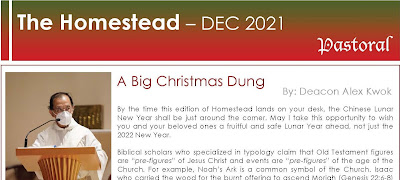
A Big Christmas Dung 一篤聖誕牛屎

A Big Christmas Dung

by Deacon Alex Kwok

By the time this edition of Homestead lands on your desk, the Chinese Lunar New Year shall be just around the corner. May I take this opportunity to wish you and your beloved ones a fruitful and safe Lunar Year ahead, not just the New Year.

Biblical scholars who specialized in typology claim that Old Testament figures are “pre-figures” of Jesus Christ and events are “pre-figures” of the age of the Church. For example, Noah’s Ark is a common symbol of the Church. Isaac who carried the wood for the burnt offering to ascend Moriah (Genesis 22:6-8) was a pre-figure of Jesus Christ who carried the cross to ascend Mount Calvary. Joseph who was sold by his brothers into Egypt was also a pre-figure of Jesus Christ who was betrayed by one of His disciples. The burning bush symbolizes the perpetual virginity of the BVM. The crossing of the Red Sea is a pre-figure of the Sacrament of baptism. The life of Jeremiah the prophet was reminiscent of Jesus Christ’s for telling the truth etc. …

We don’t need to be biblical experts to be able to see the symbolism. Here I would like to invite you to discover the highlights of our crib decorations this year. Yes, I’m sure none of you would have missed the “oxen dung” around our different cribs. In our daily life, there’s nothing likeable we are able to find in dung because a lot of unimaginable microorganisms are living inside and outside of it. Its shape and colours are disgusting and its smell nauseating. The worst of all, it attracts flies, thus spreading diseases … etc. I suppose the last thing you want to appear in your nightmares is to find yourself chained inside a dungeon of dung! Perhaps you have not read it. Jeremiah the prophet, who was accused of treason by his enemies, was thrown into a dungeon where “there was no water but mire: so Jeremiah sunk in the mire.” (Jeremiah 38:6) It takes little imagination to reason why there was dirt and mud in the dungeon. The dungeon was nothing but a septic tank to dispose of the human wastes collected in the royal palace! Pardon me for being gross! This was exactly what I felt when Father Law decorated the cribs in our church with pieces of “oxen dung” this year.

His inspiration came from a verse one of our parishioners told him, “Where there are no oxen, the crib is clean; but abundant crops come through the strength of the bull.” (Proverbs 14:4) The book of Proverbs is a collection of aphorisms contrasting the life of the wise against the foolish. In this context, the author of the Proverbs was probably encouraging his readers to work diligently like a bull! But Fr. Law took the cue and combined it with the Christmas message of our Bishop this year: “Emmanuel”, i.e. the Lord be with us! All of us are the “oxen dung”. No matter how lowly and smelly we are, our Lord is happy to accompany us. No matter how bullshit our personalities are, Jesus Christ is willing to die for us. Like all innocent children, had the Blessed Virgin Mary left the Holy Infant crawling around the floor to explore the world, Infant Jesus would have been excited to discover the warmth the manure he was massaging around his crib, remembering prophet Jeremiah whom He had sent to speak the truth.

Brethren! Fr. Law made use of every means to remind us of the plights of the needy: wheelchairs, bags of rice and Christmas muffins. Therefore what the homeless eat, we eat. Where the fragile sit, we sit with them! This is the meaning of Christmas. May I challenge you one step further. Dare you to suffer like Jeremiah in a dungeon of dung for the sake of telling God’s truth in the present milieu of Hong Kong?

Saturday, 25 December 2021

2021 A Belated Christmas Deliberation 一個遲來的聖誕思考

A Belated Christmas Deliberation
一個遲來的聖誕思考

Greeting! May the Joy and Peace of the Holy Infant be with you and your beloved in the days ahead.
祝各位與你們心愛的人,來日充滿聖嬰的喜樂平安!

I would like to show you highlights of cribs we decorated in our parish this Christmas. In the following seven photos, you’ll find some unconventional objects near the manger.

請找出以下七幅馬槽照片中的亮點,一些不落俗套的裝飾。

Yes, dung! A parishioner gave our parish priest the inspiration. “Where no oxen are, the crib is clean, but much increase is by the strength of the ox.” (Proverb 14:4) That is to say, the stronger the ox, the greater the harvest and … at the same time, the bigger the dung! Thus, we decorate our cribs with dung of different sizes. In his homily, our parish priest emphasized the meaning of Christmas: No matter how bullshit we all are, the Son of God is willing to become one of us!

對,就是在馬槽旁邊,一篤篤大小不一的牛屎!這是來自一位教友的靈感。「沒有耕牛,沒有五穀**;耕牛愈雄壯,收穫愈豐富。」(箴言14:4)言下之意,沒有耕牛,馬槽會非常清潔;收穫豐富,馬槽四周必有牛屎!堂區神父非常受落,在講道中強調聖誕的訊息,就是「天主子不計較我們一腳牛屎,樂意成為我們一份子!」
** 馬槽一詞,在英文譯本出現,思高版採用不同的譯法。
Photo Credit: the top photo came from Ms. Lilian Chin of OLMC

Sunday, 15 August 2021

論聖母蒙召升天的重要性 The Importance of the Assumption of the BVM

聖母蒙召升天節
主題:論聖母蒙召升天的重要性

天主教的信仰,絕不迷信,因為她的神學,經過千年來的推敲辯論,去蕪存菁,絕對理性。沒有足夠的哲學訓練,是不能徹底掌握的。所以這個非常理性的信仰和崇拜,絕不會導人迷信。倘若宗教信仰祇有理性的成份,頂多是人生哲理的一種,沒有可能成為一個足以鼓舞人心,甚至不惜赴湯蹈火地殉道的動力。的確,宗教的威力不在其教條,而在它對意志和情感的教化。天主教今天所慶祝的「聖母蒙召升天節」,是一個很清楚的例子,說明這個宗教並不迷信,並且合符人性的情操。

天主教信仰建基於聖經,但聖經並不會自我解說,要靠聖經學者和神學家研究它的含意。有些研究結果是公認的,教會上下成員都同意的,不需要進一步研究討論的,並且足以界定信徒身份的。我們稱這些結果是「當信道理」。例如:天主是「三位一體」,耶穌基督是「真人真天主」是作為一個基督徒所應當相信的真理,不接受這些真理,就沒有資格稱為基督徒。有些研究成果尚有討論的空間,我們稱之為「教義」,甚至祇是「神學意見」。例如,有些學者堅持按字面解經,認為天主祇造了一男一女(創1:26);有些學者認為這樣解釋聖經,會引起「亂倫」的困難(4:17)。但從聖經研究所累積到的經驗所知,正確的釋經,一般是捨易取難的…所以這些討論,到今天仍未有定案。

「聖母蒙召升天」是天主教有關聖母瑪利亞的四個「當信道理」之一。即是說,如果懷疑聖母瑪利亞死後,靈魂和肉身一起被提升到天上,就沒有資格稱為天主教徒!為甚麼這樣嚴重呢?第一,它是最遲確立的,是之前三個「當信道理」的邏輯結論,是理性的成果。第二,它符合對聖母感情上的要求,符合宗教情操。

第一個聖母的當信道理,宣認聖母瑪利亞是「天主之母」,是在公元431年的厄弗所大公會議所確立。聖母瑪利亞是受造物,造物主又怎可以是受造物所生的呢?所以當時有意見認為聖母祇誕生了天主子人性的部份,所以頂多祇是「基督之母」,不可以是「天主之母」。殊不知這種看來合符邏輯的意見,把耶穌基督的天主性與人性撕開了!因此,捍衛聖母是天主之母的身份,是捍衛天主子是真人真天主的當信道理!

第二個聖母當信道理,宣稱聖母瑪利亞在誕生耶穌前,在誕生過程中和誕生耶穌後,由始至終沒有破損她的童貞,這是公元649年的拉脫朗大公會議所確立。生物學家一定會反對這個結論,認為與科學不符!
首先,我們相信天主的人,一定相信神蹟。下雨是自然現象,但因為下雨而扭轉戰局,在有信仰的人眼中是天意,拒絕神蹟的人惟有尋求其他解釋了!我們相信神蹟是天主臨在的標記,一個祂向我們展示慈悲的痕跡。自古之來,教父認為梅瑟所見沒有焚毀的荊棘(出3:2),就是聖母卒世童貞的標記。聖嬰的出生,無損聖母的童貞,尤如祂復活時透出墳墓,不用挪開堵塞墓門的石頭一樣,是自然定律不能解釋的神蹟!耶穌基督由童貞女所生,是他的天主性的一部份。福音中提及主的兄弟姊妹(谷6:3),教父們一致認為不是聖母瑪利亞所生的。其實,聖母卒世童貞的道理,也是捍衛耶穌基督的天主性所要求的!

第三個聖母當信道理,宣稱聖母瑪利亞從成孕之始,沒有原罪。是教宗庇護九世在公元1854年頒佈的。這道理不是大公會議的決議,不但被基督新教拒絕,連東正教也採取保留的態度。雖然不在大公會議決議,教宗用了五年時間,諮詢了全球主教的意見,百份之九十支持這端教義成為當信道理。是的,這端道理經歷了長時間的爭辯,有待各種的反對意見逐漸退下纔定案下來的。這端道理與「天主之母」的道理吻合,並沒有否定聖母瑪利亞也需要耶穌基督的救贖。天主給聖子之母這特殊的恩寵,是可能並且是恰當的。要知道天主子具有真實的人性,但如何捍衛他的人性,免受原罪的傷害呢?在耶穌基督的族譜中,總要有一個轉捩點,一個界限,令原罪到此為止,不得越雷池半步。「天主為滄海劃定界限,令水不要越境,給大地奠定基礎」(箴8:29)以聖母作為這個界限,是最經濟的做法,是為了捍衛天主子的人性所要求的!

讓我們默想第四端當信道理。
即使是受造物,人類是享有尊嚴的,不應作為工具看待。所以人祇應該是目的,不可以是手段,這是人與人之間最基本的倫理要求。司祭長和長老為了捉拿耶穌而利用猶達斯,不理會他的死活。這種將人用完即棄的態度,絕對是不道德的。人與人之間的交往,尚且如此,難道天主可以不尊重按祂自己肖象所造的人類嗎?試想想,天父會不會利用完瑪利亞作為天主子進入人間的載體後,把她遺棄在世上,任由她腐朽呢?「你也絕不讓你的聖者見到腐朽」(詠16:10)雖然宗徒們引述這句話來證明耶穌基督的復活(宗2:27,13:35),但這句話應用在天主之母身上,同樣恰當!因為聖母死後,靈魂肉身最好的去處,莫過於天主的居所了!可能你會引用保祿論述復活的說話反對:「各人要依照自己的次第:首先是為初果的基督,然後是在基督再來時屬於基督的人。」(格前15:23)不錯,在基督復活與基督再來時之間,是沒有復活!但不要忘記,在舊約時代,哈諾客(創5:24)和厄里亞(列下2:11)沒有經過死亡,被接到天上去;而且在耶穌顯聖容時,厄里亞再次出現。連這些被原罪傷害了的凡夫俗子,也可以在天上享見天主子的聖容,難道被天使尊稱為「充滿恩寵者」(路1:28),天主聖神所庇蔭(1:35)的天主之母,要淪落在陰府裡等候末日復活嗎?

這端當信道理是在1950年,由教宗庇護十二世經廣泛諮詢全球主教意見後,首次引用「教宗不能錯」的權威所頒報。雖然這端道理沒有直接捍衛天主子兩性一位的真理,但它與其餘三端當信道理是前後呼應的。在理性上,聖母蒙召升天是天主聖父的公義;在情操上,是天主聖子孝順的表現;在意志上,是天主聖神的貫徹始終。這端當信道理,即使沒有聖母多次的顯現,也是無懈可擊的!
各位兄弟姊妹,我們有幸作為聖母的子女(若19:27),今天慶祝母親的升天,既有依依不捨想念之情,也有說不清的喜悅。讓我們懷著天鄉重聚的希望,跟隨聖母孕育聖言的榜樣,勤讀聖經,活出福音的精神,把福音的喜樂,感染身邊的人。
天主保祐!

2015 Reflection
圖片鳴謝:aleteia.org


Solemnity of the Assumption of the BVM
Theme: The importance of the Assumption of BVM

Catholicism is absolutely not superstitious because her theology has gone through a thousand years of debates, been purified and therefore absolutely rational. It is impossible to comprehend without sufficient philosophical training. Thus, this extremely rational faith and worship can never turn people superstitious. However, if a religion is rational only, it is at most a sort of worldview which is not able to motivate people to seek martyrdom. In fact, the power of religions lies not in their creeds but in their cultivation of will and affection. Catholics celebrate the Solemnity of the Assumption of the BVM today. It illustrates clearly how Catholicism is not superstitious but is in harmony with human sensitivity.

Catholicism is founded upon the Bible which is not self-explanatory. Believers rely on scholars and theologians to study its meanings. Some articles of faith are publicly acknowledged and agreed upon by members of all ranks and files. There is no further need to debate and analyse. Furthermore, these articles define the identity of the believers. We call these articles of faith dogmas. For example, God is trinite, i.e. three in one and Jesus Christ is both human and divine are Christian dogmas. If you do not accept these truths, you are not qualified to be a Christian. Some conclusions from studies still leave room for further discussion. We call them doctrines and even theological opinions. For example, some scholars insist on literal interpretation of the Bible. They opine that God had created one man and one woman (Genesis 1:26). Some scholars raise the difficulty of incest (4:17) in taking the literal path. However, from the past experience of biblical exegesis, scholars know that the correct interpretation usually comes from the more difficult one … The discussion is still open.

The Assumption of the Blessed Virgin Mary is one of the four Marian dogmas. That is to say, if you question whether the soul and body of the BVM were taken up to heaven after her death, you’re not qualified to be a Catholic! Why is it as grave as such? First of all, it is the latest Marian dogma, a logical conclusion of the previous three dogmas. It is rational. Secondly, it is in harmony with the affective demand towards the BVM, a proper religious affection.

The first Marian dogma, that she is the Mother of God, was promulgated in the Ephesian Council in 431 AD. But the BVM is only a creature. How could a creature give birth to the Creator? At that time, some people opined that the BVM only gave birth to the humanity of the Son of God. She could at most be called the Mother of Christ, not the Mother of God! However, this seemingly logical opinion tore apart the humanity and divinity of Jesus Christ. Thus, defending the identity of the Mother of God is in fact defending the dogma of the humanity and divinity of the Son of God!

The second Marian dogma declares that the BVM retains her virginity before, during and after giving birth to Jesus. The Lateran Council in 649 promulgated this perpetual virginity dogma. Biologists would object, thinking that it is in contradiction with science!
First of all, we who believe in God believe in miracles. Raining is a natural phenomenon. But when a downpour turns the outcome of a battle around, in the eyes of believers, it is a miracle, a God’s will. For those who reject miracles, they have to look for explanation elsewhere! We believe that miracles are signs of God’s presence, signs showing His mercy. Since antiquity, Church Fathers see the burning bush (Exodus 3:2) as a sign of the perpetual virginity of the BVM. When the BVM gave birth to the Holy Infant, her virginity was preserved just as when Christ emerged from the tomb without removing the rock that blocked the entrance. These are miracles which science cannot explain! The virginal birth of Jesus Christ is part of his divinity. The gospels mention the siblings of the Lord (Mark 6:3) whom the Church Fathers opined that they were Joseph’s children from previous marriage. In fact, the dogma of perpetual virginity of the BVM defends the divinity of Jesus Christ!

The third Marian dogma, i.e. the Immaculate Conception of the BVM was promulgated by Pope Pius IX in 1854. This dogma was not defined by ecumenical councils. Not only was it rejected by Protestants, even the Orthodox Church also holds it in reservation. Although this dogma was not a resolution of a council, it came from prior consultation of bishops all over the world for five long years. More than 90% of bishops supported declaring it a dogma. Truly, this dogma has gone through lengthy debates until opposing voices have all died down. It agrees with the dogma of Mother of God and does not deny the necessity of Christ’s redemption. That God gave this special grace to the mother of the Son of God is possible and appropriate. The Son of God is genuinely human. Then how did God defend his humanity from the damage of the Original Sin? Along the genealogy of Jesus Christ, a certain turning point, a boundary must be set up to stop the Original Sin from proceeding. God “set for the sea its limit, so that the waters should not transgress His command; when He fixed the foundations of earth” (Proverbs 8:29). Making the BVM this boundary is the most economical way to defend the humanity of the Son of God!

Let us meditate the fourth dogma.
Even though we are creatures, humanity enjoy dignity and should not be treated as tools. Man can only be an end, never a means. This is the most basic moral demand in interpersonal interactions. In order to arrest Jesus, the chief priests and elders manhandled Judas, ignoring his fate. Treating people as dispensable is absolutely immoral. This is a rule of engagement even among men. Can God disregard humanity which He created in His image? Just think about it, could the Father, after making use of the BVM as a carrier to bring the Son of God into this world, abandon her on earth and leave her to decay? “For you will not abandon my soul to Sheol, nor let your devout one see the pit” (Psalms 16:10). Although the apostles quoted this verse to prove the resurrection of Jesus Christ (Acts, 2:27, 13:35), this verse also applies to the Mother of God, most appropriately! It is because after her death, where else can be a better place to settle the soul and body of the BVM than God’s abode? Perhaps you would quote Paul’s treatise on resurrection to object, “each one in proper order: Christ the first fruits; then at his coming, those who belong to Christ” (1 Corinthians 15:23). Truly, between Christ’s resurrection and His second coming, there’s no resurrection! But don’t forget, in Old Testament times, Enoch (Genesis 5:24) and Elijah (2 Kings 2:11) were taken up to heavens without going through death. Moreover, Elijah showed up during Christ’s transfiguration. Even these mortals who were damaged by the Original Sin were able to enjoy in heaven the vision of the Son of God, would the one whom the Angel reveres as “Full of grace” (Luke 1:28), the Mother of God whom the Holy Spirit overshadows (1:35) be degraded to await resurrection in Sheol?

Using papal infallibility for the first time, Pope Pius XII promulgated this dogma in 1950 after extensive consultation with bishops all over the world. Although this dogma does not directly defend the humanity and divinity of the Son of God, it is consistent with the previous three dogmas. Rationally, the assumption of the BVM is the righteousness of the Father. Affectively, it shows the filial piety of the Son of God. In will, the Assumption of the BVM is the perseverance of the Holy Spirit. Even without the many Marian apparitions, this dogma is flawless!

Brethren! We are blessed to be children of the BVM (John 19:27). When we celebrate the Assumption of our Mother, we are filled with this lingering feeling of missing her and an unspeakable joy. Let the hope of reunion in heaven urge us to follow the example of the BVM nurturing the Word of God, to study the Bible diligently and to live up the spirit of the gospel. May we carry and pass on the joy of the gospel to our neighbour.
God bless!

Sunday, 14 March 2021

菁英主義 Elitism

四旬期喜樂主日,乙年
主題:菁英主義

在起初,基督信仰承受著不同的磨難,逐漸壯大起來。教會在享受和平的時候,反而變成腐敗。難道人真是賤骨頭,「生於憂患,死於安樂」嗎?
耶穌基督是猶太人,嚴格地說,第一代信徒全部都是猶太人。(雖然十字架下的羅馬百夫長曾經宣信,但福音沒有他跟隨主耶穌的紀錄。)猶太人相信惟一真神,基督徒卻相信一個木匠是天主子。因此在猶太人眼中,這些猶太人基督徒是分裂猶太教的叛徒,所以歸化前的保祿,熱切地掃蕩基督徒。
另一方面,在羅馬帝國眼中,這些拒絕向羅馬眾神獻祭的基督徒是「無神論者」,是戰敗和疫症的最佳「代罪羔羊」,可以把人民對統治者的忿怒,轉嫁到他們身上!蒙天主的護祐,基督徒以「家庭教會」、「地下教會」的形式,走過艱難的歲月,在君士坦丁凱撒統治時,終於可以享有宗教信仰的自由,不受干擾地公開表達他們的信仰。 基督徒在自由交換經驗的日子,發現了不少基本信條上的分歧。這些神學上分歧的觀點,各有擁護者,足以分裂教會!君士坦丁為了防範未然,在公元325年召開尼西亞大公會議。不錯,教會的大公會議是羅馬帝國的皇帝召開的。所以說「政教分離」的人,是生活在空中樓閣,不在人類的歷史中!當時教會急於處理的神學問題,就是「天主子是否天主」,即「三位一體」的問題!在牧民問題上,要決定「復活節」在哪一天。尚待處理的問題是如何接納教難時背教的信徒及神職人員問題…基督信仰開始系統化了。
不要以為問題可以斬釘截鐵地解決,因為有些分裂的思想,會陰魂不散,在往後的世代,以新的面貎出現!例如「白拉奇主義」。教宗方濟各在2018年發表的《你們要歡喜踴躍》宗座勸諭,便指出它是兩個「導致我們誤入歧途的錯誤成聖觀念」之一。它「以人為中心的內在論,但偽裝為天主教信仰的真理…專制式的菁英主義…」(GE#35)

「自食其力」無疑是一種美德,《箴言》以「腰纏萬貫」勸導人勤勞(箴12:27);保祿宗徒傳福音時,亦堅持勤勞地操作,免得加重任何信徒的負擔(得前2:9;得後3:8),立下了令人肅然起敬的榜樣,天主肯定欣賞這種勤奮的態度。可是,在有關成義得救方面,人是沒有能力自救的。簡單地說,我們每個人祇有一條生命。試問那些殺死了超過一個人,令超過一個人殘廢的兇手,有甚麼能力償還他們的罪債呢?所以,我們的得救,是出於天主的恩寵,不是出自個人的努力。正如今天的第二篇讀經所說:「因為你們得救是由於恩寵,藉著信德,所以得救並不是出於你們自己,而是天主的恩惠;不是出於功行,免得有人自誇。」(弗2:8-9)可是,人始終念念不忘自己的努力,從興建巴貝耳塔(創11:4)到回頭的蕩子(路15:19),都希望以成就來肯定自己的地位;從禁食的爭論(谷2:18)到法利塞人與稅吏祈禱的比喻(路18:11-12),人始終喜歡以所做到的事,互相比較!因此,「白拉奇主義」便有市場了。在第五世紀,他們相信原罪並沒有完全傷害了人性,即使沒有恩寵,人憑意志和努力,也可以滿足天主要求我們所做的事,而天主絕不會要求我們做不可能的事。是聖奧思定駁斥了「白拉奇主義」的錯謬。但「白拉奇主義」是不會這樣輕易消失的,因為人歡喜互相比較,這就是教宗方濟各提及的「專制式的菁英主義」了。

曾幾何時,禮儀的改革讓信友可以更積極主動起參與彌撒。跟著,有不少的爭論出現了: 舉行彌撒時,應朝向東方,而且祭台上應該放一個十字架、念「天主經」的時候,教友不應模仿神父把雙手攤開、站著手領聖體對聖體不虔誠,對耶穌基督不敬、不應送聖體給離婚教友、應該把同性戀者拒諸門外、教會應該發聲明譴責暴力…這些基督徒「以自身的努力成義,並崇尚人性的意志和個人的能力…偏執法律,迷戀於社會和政治的得益,炫耀禮儀、教義或教會的威望,為管理具體事務的能力而自詡,為自我提升和自我實現的項目而著迷。」(GE#57)連神職人員也不能倖免!「白拉奇主義/菁英主義」並不是教會的專利,社會上、政治上俯拾皆是。上世紀政府公務員是大學畢業的社會精英,將來是「根正苗紅」的愛國人士。

「恩寵」與「善行」之間的爭論,並沒有因保祿和雅各伯的書信得到解決,聖奧思定也未能杜絕「白拉奇主義」,今天仍陰魂不散地,以神職主義、菁英主義、種族主義和白人優越主義等,在教會內和社會上揮之不去。很明顯,各執一端解決不了問題,平衡兩者纔是出路。即使不用雅各伯的名句:「信德沒有行為也是死的」(雅2:26),保祿根本沒有排除善行:「惟有以愛德行事的信德,纔算甚麼。」(迦5:6)很明顯,恩寵與善行,是走天國之路的兩條腿,缺一不可。因此,堅持「惟獨XX」是行不通的。況且,五個「惟獨」,已經不是「獨一無二」,豈不是自打嘴巴嗎?游手好閒,不與天主合作,恩寵祇會白費;沒有真理和愛,善行亦祇會變成「白拉奇主義/菁英主義」!

各位兄弟姊妹,今天是四旬期的「喜樂主日」。在這疫症全球肆虐,世界各地的民主遭受打壓的艱難時刻,有甚麼值得喜樂呢?
天父是慈悲的,祂不願看見罪人喪亡。但祂尊重祂賜給我們的自由意志,不會強迫我們相信耶穌基督,不會要求我們成為精英纔得救,這就是我們值得喜樂的原因之一。當我們相信祂派遣來到世上的聖子,遵行耶穌基督彼此相愛的誡命,守望相助,服務貧困的人,有能力帶給世界小許溫暖,這就是值得喜樂的原因之二。若望說:「審判就在於此:光明來到了世界,世人卻愛黑暗甚於光明…然而履行真理的,卻來就光明,為顯示出他的行為是在天主內完成的。」(若3:19,21)愛德的行為,合符真理,因為天主是愛;我們的善行是在天主內完成的,所以我們不受審判;這就是值得喜樂的原因之三。
喜樂吧,天主保祐!

2018年講道
圖片鳴謝:royalperspectives.com


Laetare Sunday, Year B
Theme: Elitism

In the beginning, Christianity grew amid various persecutions. When the Church had a taste of peace, she corrupted. Is humanity so irreparable that it lives in adversity and dies of comfort? Jesus Christ was a Jew. Strictly speaking, all the first generation disciples were Jews. (Although the Roman centurion proclaimed his faith under the cross, we do not find records of his following Jesus in the gospels.) Jews believed in one true God but Christians believed a carpenter to be the Son of God. Thus, in the eyes of Jews, these Jewish Christians were heretics. That was why before his conversion, Saul zealously persecuted Christians.
On the other hand, in the eyes of the Roman Empire, these Christians were atheists because they refused to offer sacrifice to the Roman deities. They were handy scapegoats for defeats and plagues. People in power could easily avert commoners’ anger and frustration towards rulers to Christians! Thanks to God’s protection, Christians were able to weather through those difficulties in the form of domestic churches and underground churches. At last, in the time of Constantine Caesar, Christians were able to enjoy religious freedom, expressing their faith in public without fear.
When they came together to freely exchange their experiences, they discovered many disagreements among basic articles of faith. Each of those divergent theological opinions had their own supporters, numerous enough to split the Church! To nib schism in the bud, Constantine convened the Nicaea Council in 325 A.D. Yes, the ecumenical council was convened by the Roman Emperor. Those who insist on the separation between state and religion are living in castles in the air and not in human history! The urgent theological business to handle is the question whether the Son of God is God, the Trinity problem! On the pastoral side, they needed to decide the date of Easter. Business on the pipeline was how to deal with apostate believers and clergy who wanted to return to the Church … Christianity began to systematize.
Nothing can be more wrong if we think that these controversies could be settled once and for all. Indeed, these heresies keep coming back in subsequent generations in new disguises! For example, Pelagianism. In his apostolic exhortation “Gaudete et Exultate” issued in 2018, Pope Francis pointed out that it is one of the “two false forms of holiness that can lead us astray”. They “reflect an anthropocentric immanentism disguised as Catholic truth … a narcissistic and authoritarian elitism” (GE#35).

Enjoying what your hands provide” is without any doubt a virtue. The Book of Proverbs uses “splendid wealth” to advocate the virtue of diligence (Proverbs 12:27). Paul insisted on working night and day while at the same time proclaiming the gospel so as not to burden any of the disciples (1 Thessalonians 2:9; 2 Thessalonians 3:8). He set up a respectable exemplar. God definitely likes this diligent attitude. However, in matters of justification and salvation, men are unable to save themselves. Simply put, we have only one life. How can a murderer who kills or maims more than one person repay his debts? Thus, our salvation comes from God’s grace, not our own efforts. From the second reading today, we have, “For by grace you have been saved through faith, and this is not from you; it is the gift of God; it is not from works, so no one may boast.” (Ephesians 2:8-9) But how can men forget their labour? From the Tower of Babel (Genesis 11:4) to the Prodigal Son (Luke 15:19), men want to affirm their status with their achievements. From the controversy over fasting (Mark 2:18) to the parable of the Pharisee and Publican (Luke 18:11-12), men want to compare their achievements! Thus, Pelagianism has its market. In the fifth century, they believed that the Original Sin had not damaged the human nature. Even without grace, men were able to satisfy God’s demand with their own will and efforts. After all, God would not demand the impossible. St. Augustine refuted Pelagianism. But it refuses to die away easily because men like to compare. This is the authoritarian elitism which Pope Francis mentioned above.

Liturgical reforms aim at encouraging more active participation of the faithful in mass. Then many controversies follow: priests should celebrate masses facing the East and there should be a crucifix on the altar; when saying the Pater Noster in mass, the congregation should not open their arms in the manners of priests; it is impious to receive the Holy Communion in hand and standing, this is not respectful to Jesus Christ; the divorced should be denied the Holy Communion; homosexuals should not be admitted; the Church should condemn violence … These Catholics insist on “justification by their own efforts, the worship of the human will and their own abilities … an obsession with the law, an absorption with social and political advantages, a punctilious concern for the Church’s liturgy, doctrine and prestige, a vanity about the ability to manage practical matters and an excessive concern with programmes of self-help and personal fulfilment.” (GE#57) Even the clergy are not exempted. Pelagianism/Elitism is not the Church’s monopoly. It is not in short supply in the social and political spheres. During the last century, civil servants were elitist graduates. In the future, they will only be patriots of crimson background.

The controversy over grace and good works is not settled by letters from Paul and James. St. Augustine was unable to uproot Pelagianism which persistently emerges again and again within and without the Church in different guises of clericalism, elitism, racism and white supremacy etc. Obviously, taking side is unable to solve the problem. Balancing them is the only exit. Putting aside James’ immortal quote “faith without works is dead” (James 2:16), Paul does not ignore work. Nothing counts, “but only faith working through love” (Galatians 5:6). Obviously, grace and works are the two legs we need to walk to heaven. Missing one of them, the journey will fail. Thus, insisting on “Sola xxx” doesn’t work. Moreover, isn’t it contradictory to have five solae, making them not sola together? Being sloth and does not work with God is a waste of grace. Without truth and love, works would become Pelagianism/Elitism!

Brethren! Today is Laetare Sunday. It is indeed a harsh time when the pandemic is still rampant and democracies all over the world are undergoing oppression. What can make us joyful?
The Father is merciful. He does not want to see sinners perish. But He also honours the free will He grants us and would not force us to believe in Jesus Christ. He would save us even if we don’t become elites. This is the first reason to make us joyful. When we believe in the Son He sent, observe the love each other commandment Jesus Christ gave us, become our brothers’ keepers and are able to serve the needy to make this world a little bit warmer. This is the second reason we can be joyful. John says, “And this is the verdict, that the light came into the world, but people preferred darkness to light … But whoever lives the truth comes to the light, so that his works may be clearly seen as done in God.” (John 3:19, 21) Charity agrees with truth because God is love. Our works are done in God and we are not judged. This is the third reason why should be joyful.
Therefore, rejoice! God bless!

Sunday, 3 January 2021

如入寶山空手回 Leaving the Treasure Trove Empty-Handed

主顯節,乙年
主題:如入寶山空手回

不得不承認,財富是走遍世界的通行證。瑪竇的聖誕故事也呈獻上這樣的一個意象。君不見東方賢士可以覲見大黑落德─歡迎與否,另當別論─但聖家卻要星夜走難到埃及嗎?誠然,不同的朝代,對於外國人的態度不同。歸根究底,除了財富之外,也有不少的政治因素。而政治總離不開利益與權勢的分配,到頭來,利益祇不過是短期或長線的財富而已!所謂「無財不行」,沒有金錢的潤滑,世事不能暢順地運轉!文化交流,促進世界大同─最少在現代而言─倘若不會帶來任何經濟或者政治上的利益,恐怕祇是夢想而已。

對於外國人,因為對他們認識不多,免不了保持著一份戒心,提防他們對自己的國家做成傷害:如果你與敵國作戰,這些外人可能是來刺探軍情的間諜;即使不在戰爭時期,從外國來投資的商人,雖然為本地人製造就業機會,但他們也可以乘機刺探工商業上的秘密…除非你好像唐朝的君主,對自己的文化及各方面的制度,充滿信心,認為自己是泱泱大國,樂意向周邊國家送禮,展示國力,並且歡迎外國派人來學習。否則,你一定會懷疑來者的意圖,最後甚至採取閉關的政策!
作為羅馬帝國的一個僕婢,大黑落德沒有那份泱泱大國的信心。所以在接見東方賢士之前,一定會從老遠監視著他們:他們是否一支來自絲綢之路的商旅呢?是否羅馬帝國的附庸國派來,沿途搜集情報,向凱撒匯報,誰有叛國嫌疑的探子呢?賢士帶著的財寶,可能是一種掩飾。他們不一定真是做買賣的商人,但這財寶不失為一個管用的通行證。其中的三份禮物:黃金、乳香和末藥(瑪2:11),可能成為了聖家將來避難時的通行證!

這些來歷不明的外人,帶來了一個轟動的訊息!為群眾,這「纔誕生的猶太人君王」(2:2)真是悲喜交集的訊息!這「新生王」有可能是預許的「默西亞」,終於,獨立自主的時期快到了,再忍耐多十八年…不過,大黑落德的妻妾,近期並沒有為他誕下王子。大黑落德聽到這個「新生王」消息,會有甚麼反應呢?群眾不敢再想像下去,但想下去與否,也不能挽回即將發生的噩耗,全耶路撒冷祇有驚慌地等候宣判(2:3),看哪個村鎮的嬰兒,會不幸成為死囚!果然,真是白冷,達味的家鄉,這個新生王真是「默西亞」!
大黑落德不是一個昏君。後世把他形容是個暴君,除了他的殘暴手段外,還有他的老謀深算!當前,羅馬帝國是他的主子,為了消除凱撒對他的疑心,有甚麼比鏟除「默西亞」更有效呢?即使東方賢士不是羅馬派來的探子,他們帶來的訊息,真是一份大禮!於是大黑落德便導演一齣好戲給凱撒和猶太人看!
猶大有很多有名的地方,出過不少英雄豪傑,例如基德紅的家鄉,敖弗辣(民8:32),三松的家鄉,祚辣(13:2),撒慕爾的家鄉,辣瑪(撒上1:1)…但有那個地方比默西亞的祖先,達味的家鄉白冷更適合呢?大黑落德還說了一個太明顯的謊言:「好讓我也去朝拜」(瑪2:8),說一個沒有希望欺騙到賢士的「謊言」,目的祇有一個:如果賢士是探子,就把這個口訊:「好讓我去除掉他」,帶回凱撒。如果他們是天真的賢士,就留給他們一個好印象吧!一切已成定局,以後的,就成了歷史!

執事是否太有想像力呢?可能是。但無論如何,做夢的人仍可以繼續做他的夢,但老謀深算的人,祇有一個結果:人算不如天算!大黑落德坐在寶藏上,卻拱手把它讓與別人!實在太諷刺了。
也難怪,大黑落德對上主天主是否「孝愛、敬畏」,就不用說了。沒有敬畏,何來智慧?缺乏智慧,老謀深算也祇會變成愚昧(箴1:7)。大黑落德沒有聖神恩賜的「智慧」,他所渴求的,是保障著眼前的權勢和財富,而不是天上的賞報。他沒有聖神的「超見」,糾正他扭曲了的價值觀。因此,對是非黑白,作出了錯誤的判斷。斬草除根,防範未然,於是屠殺無辜的嬰孩,做出一件極可怕的惡事。如果把他屠殺無辜嬰孩的手段,祇說是缺乏愛德,真是犯下為當權者塗脂抹粉的罪過。作為君王,他有責任保障人民的生命財產,但他竟然謀殺社會未來的主人翁!他不但不尊重生命,更是對未來造成傷害,成為名副其實的「千古罪人」!

本來這是上主天主施恩的日子,祂賜給世人一份大禮,把自己的獨生子賜給世人,帶給他們自由,讓他們自由自在地發展。可惜,上主施恩的日子,竟成了世上的君王與上主的一場角力!他們不但錯失了蒙恩得救的機會,還帶給其他無辜者不幸。一如孟子所說:「是以惟仁者宜在高位。不仁者而在高位,是播其惡於眾也!」(孟子‧離婁上)上主大智大仁,即使不仁者如何播惡,亦未能阻擋和改變上主對罪人的慈悲。

各位兄弟姊妹,大聖若瑟在這事件上,樹立了至順和至忠的榜樣。在大聖若瑟年,讓我們以大聖的榜樣,至順、至忠地履行天父的旨意。
天主保祐。

2018年講道


Solemnity of the Epiphany of the Lord, Year B
Theme: Leaving the Treasure Trove Empty-Handed
It is undeniable that wealth is the passport for you to travel all over the world. Matthew's Nativity narrative paints us just such a picture. Don't you see how the Magi from the east were granted an audience with Herod the Great, whether they were welcomed would be another story, while the Holy Family had to flee to Egypt? Of course, some dynasties were xenophobic while others were not. But at the end of the day, other than wealth, there are many political considerations. And politics have to do with the distribution of power and resources. It all comes back to wealth in the short term or in the long term! Money is the lubricant without which, things cannot move smoothly! If cultural exchanges in the view of global solidarity don't carry economic or political advantages, they could only be dreams, at least for the present age.

People naturally are cautious in dealing with aliens because we don't know much about them and worry about their doing harm to our countries. If you are engaging in a war, these aliens can be spies stealing military information. Even in peace time when foreigners invest and create employment opportunities for local people, they may take chances to engage in industrial espionages … Unless you are as confident as Tang emperors in the culture and social institutions of your kingdom and think of your kingdom as the Empire, it's difficult to imagine showering neighbouring countries with magnificent gifts to show off the power of your empire, and embracing foreigners who come to study. In most cases, you would doubt the intentions of aliens and even lock up your own country!
As a "handmaid" of the Roman Empire, Herod the Great lacked the confidence of a great empire. Thus, before granting an audience with the Magi, he must have them under surveillance from afar: Were they merchants coming from the Silk Road? Were they spies of Roman vassals, collecting information and reporting to Caesar who would be guilty of treason? The treasures brought by the Magi would probably be a camouflage. They might not be merchants. But treasures were handy passports. The three gift among the treasures: gold, frankincense and myrrh (Matthew 2:11) probably provided "passport" for the Holy Family's exile to Egypt!

These aliens from nowhere brought an unsettling message! For the commoners, this "Where is the new born king of the Jews" message was both bitter and sweet! This "New Born King" could possibly be the anticipated "Messiah". At last, independence and autonomy would be within sight after waiting for yet another 18 years … But the wives or concubines of Herod the Great had recently not given birth to any prince. What would Herod the Great do after hearing the news? Commoners dared not to think further. But whether thinking or not would not change the course of imminent tragedy. All Jerusalem was troubled (2:3) and waiting anxiously to see which town whose children would be so unfortunate as to be condemned! It turned out to be Bethlehem, the native town of David. This New Born King was truly the Messiah!
Herod the Great was not stupid. He was labelled a tyrant not only because of the atrocities he commanded, but also because of his calculations! At that time, the Roman Empire was his master. What would be more effective in removing all of Caesar's doubts than eliminating the Messiah? Even if the Magi were not spies from Rome, their message was a big gift fallen out of the sky! Thus, Herod the Great choreographed a drama for Caesar and all the Jews to enjoy!
There were many famous places where heroes were born. For example, from Ophrah came Gideon (Judges 8:32), from Zorah Samson (13:2) from Ramathaim Samuel (1 Samuel 1:1) … But where else could be more appropriate in producing the Messiah than the home town of David? Yes, it must be Bethlehem. Furthermore, Herod the Great told a lie too obvious not to be detected, "That I too may go and do him homage" (Matthew 2:8). Telling a lie without the slimmest chance to cheat the Magi had only one purpose: if the Magi were spies, they would pass this message to Caesar, "That I may go and do him harm." If the Magi were naïve enough, this lie would simply leave them a good impression! The stage was set. The rest is history!

Am I over-imaginative? Probably! But whatever, day dreamers may continue to dream while there is only one outcome for the calculating people: They shall never outwit God! Herod the Great calculator was sitting on a treasure trove. Yet he allowed it to slip through his fingers! How sarcastic!
This is to be expected. Not to mention that Herod the Great had no piety or fear of the Lord, he lacked wisdom. Why? Without the fear of the Lord, where comes wisdom? Without wisdom, calculations would only turn to foolishness (Proverbs 1:7). Herod the Great lacked the wisdom given by the Holy Spirit. His only desire was to keep the power and wealth at the moment and not rewards above. He lacked the counsel of the Holy Spirit which would right his wrongs of twisted priorities. Thus, he made wrong judgments. In order to nip the Messiah in the bud, he ordered the massacre of the Holy Innocents, a truly evil act. If we say killing the innocent infants was only a lack of charity, we commit the crime of whitewashing the evil of people in power. As a king, Herod the Great had the duty to protect the lives and property of the people. But he decided to murder the masters of the future! Not only did he show no respect for life, but he was doing the future generation great harm. Herod the Great deserved to be named "The Sinner of A Thousand Ages"!

It was supposed to be a day for God to show mercy. He gave humanity a big fat gift, His only begotten Son, to liberate us, allowing us to grow and develop in freedom. Regrettably, this day of mercy had turned into a mortal combat of kings and princes against God! Not only did they miss the opportunity to receive grace and salvation, but they also spelt misfortune on the innocent. Mencius rightly comments, "Only the Benevolent should occupy high positions. When the Maleficent occupy high places, they spread evils to many!" (Mencius, Li Lou I) The Lord is wise and benevolent. Even when the maleficent are spreading evils, they are unable to block or change God's determination to be merciful to sinners.

Brethren! St. Joseph had shown perfect obedience and loyalty in this incident. During the Year of St. Joseph, let us follow his exemplar to do the Father's will in obedience and loyalty.
God bless!

Sunday, 8 November 2020

敬畏上主的恩典 The Gift of Fearing of the Lord

常年期第三十二主日,甲年
主題:敬畏上主的恩典

世界已變得越來越世俗化,大部份現代人對聖經的訊息,不感興趣。即使有興趣,也要放下很多包袱,纔能得到正確的理解。例如要接受今天福音所教訓,就必須要克服對「童女」的偏見。在滿腦子「人權」和「平等機會」的城市人心中,為甚麼是「童女」而不是「童男童女」,甚至祇是「男女」?在今天講求「男女平等」的現代社會,福音實在與現代人的生活太脫節了!那邊廂,倡議女權主義者必定會抗議耶穌選用「童貞女」這個圖像,否定女性對自己身體的主權。尚若祇有「童貞女」纔可以進入天國,不進天國也罷!二千年前是習俗,是理所當然的事,今天卻被人唾棄!在廿一世紀成聖的難度,的確要跨越很多困難!

所以,我們需要澄清一些運用比喻的原則,避免那些浪費時間和精力的爭辯。
首先,直接論述一些深奧的道理,恐怕祇有少數訓練有素的學者,纔有能力明白。這樣做會把大部份人拒諸門外,有違天主願意眾人得救的本意。讓大部份人明白的事物,就是日常生活可以接觸到的事物。所以耶穌基督按照「近取諸身、遠取諸物」的教學方法,以日常生活的材料,描述天國。
第二,有本領從「一顆沙粒看見宇宙,一朵野花參透天堂」(威廉‧布萊克《天真的徵兆》),固然是大智慧的表現。但這詩句背後的意景,告訴讀者,即使是普通的材料,亦足以描述天國的奧秘!所以運用童女迎接新郎的習俗來描述天國,是可行的。
第三,倘若耶穌在廿一世紀講述同樣的比喻,祂一定會選用今天的材料做圖像,例如參加奧運的運動員。有些運動員積極操練,有些隨便,更有些借用禁藥…二千年前在希臘舉行的奧運會,絕對不及婚禮習俗的普遍。同樣道理,倘若二千年後再沒有奧運會,或者人類社會再沒有婚姻制度,童女與運動員的圖像,同樣變得脫離現實了。每個圖像都有它們的「上架年期」,恐怕這是運用圖像的局限性。始終圖像不是它所象徵的事物本身!

在古時,不少教父曾在著作中或講道中,注釋「十童女」的比喻。他們普遍地把「十童女」解釋為教會。所以這個比喻的對象不是全人類,而是已經領洗入教的人。雖然天主願意所有的人得救(弟前2:4),但祂給予眾人平等機會的同時,亦不能強迫所有人接受祂的邀請。所以設下了篩選的機制,限制祇有信奉耶穌是天主子的人(若一4:15),纔有資格參加天上的婚宴,是合理和公義的!
耶穌基督選用了「童貞女」來象徵那些回應天主的邀請,專心一意事奉天主的人(瑪5:86:24),並沒有否定女性對自己身體的主權。而教會堅決反對的,是濫用主權,殺害無辜者生命的行為。這樣做,對天主作為生命的主宰是大不敬,是有害而無益的。另一方面,由「童貞女」迎接新郎,然後一起赴宴,既是當時的習俗,又能表達天上婚宴的事實,是當代最恰當的圖像了。

教會內有聖人,有罪人,是眾所周知的事實。可是,最終的比例有多少呢?恐怕祇有天主纔知道。耶穌基督用五個明智,五個愚昧的比例,是正確的安排。倘有六個是明智的,會令人過份樂觀,心存僥倖;倘若六個是愚昧的,會令人灰心喪志!
點燈是為了照亮四周,在瑪竇福音,那照耀的光是指基督徒的善行(5:16),是光榮在天之父的愛德服務。這些愛德服務有別於一般的社會福利,因為是為了「光榮在天之父的」。所以不是對所有人的要求,而是對那些接受邀請,參加天上婚宴者的要求,是他們應該穿著的「婚宴禮服」(22:12)。所以天主教徒要緊記,行善是參加婚宴的入場券,是「孝愛天主」,同時也是為了傳福音,為了令人光耀天主。

「油」既然是發光的燃料,便是行善的動機和能力了!那麼,富有的人有優勢嗎?可幸耶穌基督曾稱讚在聖殿銀庫投下了兩個銅錢的窮寡婦,所以天主仍不失為公義的天主,不是信奉「精英主義」的天主。其實,微不足道的我們,無論行善的數額有多大,無限的天主是不會放在眼內的!因此,祇餘下「動機」一項須要考慮。由此可見,「燈快要滅」(25:8),不是因為沒有了行善的資源,而是失去了行善的正當「動機」。正當的動機祇有一個,就是愛近人的同時,孝愛天主。幾時人為了沽名釣譽,為了接受人們的稱讚而施捨,便會失去了天主(6:1-2)。對不起,動機是不能分施給其他人的。所以,明智的童女,不是出於自私而拒絕分享,而是根本沒有可能分享!但「動機」可以買來的嗎?當然不可以,正當的動機是經年累月,培養出來的。臨急抱佛腳,難怪這些愚昧的童女,最終被拒諸門外。

值得留意的,是明智童女的態度。即使終日抱著正確的動機行善,她們仍然保持一份戰戰兢兢的心態,「怕為我們和你們都不夠」(25:9)。明智的童女是明白「諸聖相通」的道理,她們真的沒有私心,不是祇為了自己而行善,也為了其他同行者的益處行善。另一方面,她們對上主那份敬畏之情,令她們不敢怠慢,終日乾乾!「敬畏上主是智慧的肇基」(箴9:10),難怪她們是明智的。恐怕那些愚昧的童女之所以愚昧,是失去了「敬畏上主」的恩典所致罷!

各位兄弟姊妹,「聖神七恩」是環環相扣的,而且一切都是從「敬畏上主」開始的。世俗主義令人自大,是喪失「敬畏上主」的致命傷。失去「敬畏上主」便沒有智慧;沒有智慧,在各方面都不能明辨是非,隨波逐流,距離天國,越漂越遠。所以,祈求天主聖神,從新激活我們在領受「堅振聖事」所獲得的聖神七恩吧! 天主保祐!
2017年講道
圖片鳴謝:vaticannews.va


Thirty Second Ordinary Sunday, Year A
Theme: The Gift of Fearing of the Lord

The World is becoming more secular. Most modern people are not interested in the messages of the Bible. Even for those who are interested, they need to overcome many obstacles in order to attain a correct understanding. For example, in order to accept the teachings of today's gospel, people need to overcome the prejudice against "virgins". The minds of urban citizens are full of human rights and equal opportunities. They would find "virgins" offensive. Why just girls? Why not boys and girls? The gospels have truly lost touched with lives in modern societies which emphasize gender equality! On the other hand, feminists would protest against Jesus for using the image of "virgins" which denies the autonomy of women over the use of their own body. If only virgins could enter the Kingdom of Heaven, forget it! Two thousand years ago, people took the custom for granted. Today, the custom has become offensive! It is getting more and more difficult to attain sainthood in the twenty first century!
Thus, in order not to waste time and energy in futile arguments, we need to clarify the principles behind the use of parables.
First of all, if we explain difficult truths directly, I'm afraid only a handful of well-trained experts would be able to follow. Most people would become outsiders. This goes against God's will for all to be saved. In order to make most people understand, it is necessary to use familiar objects in daily life. Following this pedagogy of "using familiar objects", Jesus Christ makes use of things in people's daily life to talk about the Kingdom of Heaven.
Secondly, the ability "To see a World in a Grain of Sand And a Heaven in a Wild Flower…" ("Auguries of Innocence", William Blake) is great wisdom. But the imagery behind the couplet assures readers that even ordinary materials are able to convey the mysteries of the Kingdom of Heaven! Thus, using the custom of maidens waiting to meet the bridegroom is a legitimate symbol to talk about the Kingdom of Heaven.
Thirdly, if Jesus is to tell the same parable in this twenty first century, He will surely employ modern images such as Olympic athletes. Some athletes train diligently while others casually and some even use enhancement drugs … Two millennia ago, Olympic Games in Greece were definitely not as common as marriage customs. Similarly, in two thousand more years, there might not be Olympic Games or the institution of marriage in human societies anymore. Both images of virgins and athletes would lose touch with reality. Each image has a "shelf-life" which is the limitations of all images. After all, images are not what they symbolize!

In ancient times, many Church Fathers explained this parable of ten virgins in their treatises and homilies. In general, they agreed that the virgins symbolized the Church. Thus this parable is not meant for all humanity but those who were baptized. Even though God "wills everyone to be saved" (1 Timothy 2:4), while He gives all people equal opportunities, He cannot force people to accept His invitation. Therefore, setting up some election criteria, allowing only those who believe that Jesus is the Son of God (1 John 4:15) to join the heavenly banquet is reasonable and righteous!
Jesus Christ makes use of the image of virgins to symbolize those who respond to God's invitation to serve Him exclusively (Matthew 5:87, 6:24). That does not deny the autonomy of women over the use of their own body. The Church only opposes the abuse of autonomy to kill innocent lives. Doing so is a great rebellion against God who is the Author of Life. It is extremely harmful. On the other hand, virgins waiting to meet the bridegroom to attend wedding banquet was not only a custom, but it also expresses the reality of the heavenly banquet at the end of the world. Therefore, it is the most appropriate image at that time.

It is a truism that there are saints and sinners within the Church. But in the end, what will the proportion be? I'm afraid only God knows. Jesus Christ arranges 5 prudent and 5 foolish virgins in the parable. This is an appropriate proportion. If there are 6 prudent virgins, people may become over optimistic and tend to take chances. If there are 6 foolish virgins, people may become discouraged. People light a lamp to give light to all in a house. In the gospel of Matthew, this light is the good deeds of Christians (5:16) which are charitable works to glorify their heavenly Father. These charitable works are different from services of social welfare because glorification of heavenly Father is the aim. Thus, it is not a demand for all humanity but for those who have accepted the invitation to join the heavenly banquet. It is the wedding garments they should put on (22:12). Therefore, Catholics should bear in mind that charity is the admission ticket to the heavenly banquet. It is piety shown to God and at the same time an act of evangelization so that people shall glorify God.

"Oil" is the fuel that gives light. Then it is the motive and capability to do charity. Would the rich have an edge? Fortunately, Jesus Christ praised the poor widow who dropped in two brass coins in the Temple treasury. After all, God is still a righteous God, not an elitist God. Indeed, we are nothing but dust. However huge our donations are, in the eyes of our infinite God, they are nothing. Therefore, there is only one item, viz. the motive to consider. From this perspective, the reason the "lamps are going out" (25:8) is not a lack of resources, but the vanishing of the proper motive to do charity. There is only one proper motive, viz. to love our neighbour and at the same time, to be pious to God. Whenever people give alms for fame and praises from the others, they lose God (6:1-2). Sorry, motive cannot be shared. Thus, the prudent virgins do not share out of selfishness. It is just impossible to share. But can motive be purchased? Of course not! Proper motive takes years to cultivate. No wonder the foolish virgins who took chances at the last minute were locked out.

We should take note of the attitude of the prudent virgins. Even when they were doing charity with a proper motive, they were still trembling with fear, lest "there may not be enough for us and you" (25:9). The prudent virgins understand the article of faith, viz. "the communion of saints". They are not selfish. They do charitable works not only for themselves but also for the good of their companions. On the other hand, their fear of the Lord prods them on, not daring to be complacent for a moment! "The beginning of wisdom is the fear of the Lord" (Proverbs 9:10) No wonder they are wise. I'm afraid the foolish virgins are foolish because they have lost the gift of "the fear of the Lord"!

Brethren! The seven gifts of the Holy Spirit are linked together and they begin with "the Fear of the Lord". Secularism inflates people's ego. It is the dart that kills "the Fear of the Lord" in men. Losing the Fear of the Lord loses wisdom. Without wisdom, we cannot discern right from wrongs. We flow with the current and stray from the Kingdom of Heaven. Thus, pray to the Holy Spirit to re-ignite the seven gifts we have received in the Sacrament of Confirmation! God bless!

Wednesday, 14 August 2019

為所有香港警察祈禱 Pray for the Hong Kong Police Force

為所有香港警察祈禱
聖高比神父(St. Maximiliani Mariae Kolbe, OFM)在集中營有為虐殺他們的納粹軍官祈禱嗎?熱心推動無玷童貞聖母瑪利亞敬禮的他一定有。所以今天默想為香港警察祈禱是很合時的。

香港不是集中營,但試問今天有多少香港人能置身事外,夢遊離開這片土生土長的家園呢?所以生活在香港的基督徒,尤其是天主教徒,更應效法聖高比神父的榜樣,為香港的警察和他們的家屬祈禱;他們辛苦了。

我們應該把從大陸來加入的和在本地受訓的警察分開嗎?他們在遊行時做「臥底」,推動群眾衝擊,給其他同袍開火的藉口;執行任務時拒絕不出示委任証;不按學堂的訓練,舉槍向示威者平射;在民居附近及不通風的地方發射催淚彈;不按程序辦事,沒有法庭手令,擅闖私人地方;拘捕示威者後不是唸「你有權保持沈默…」,而是揮動警棍狂毆已沒有反抗能力的被捕人士;插贓嫁禍… 這些從大陸來的外勞,把香港警察,艱苦經營了幾十年,在市民心中所建立的清廉、忠心、專業、除暴安良的英雄形象,完全破壞了!

對不起,不可以分開。讓我們試從他們的角度思考吧!香港的青年人嬌生慣養,沒有人願意捱苦,在香港又沒有stakes,因此警隊輸入外勞,無可厚非。所以基督徒要不分顏色,為香港所有的警察祈禱!

為甚麼祇是祈禱,而不參加「撐警大會」呢?因為市民街坊,已不敢接近警察,給他們送上鮮花或桂冠。有些甚至唾罵他們,驅趕他們。作為基督徒,我們不能唾罵驅趕,我們應該實踐主耶穌基督吩咐我們為迫害者祈禱的教訓,在祈禱中擁抱疲累的警察。我們應學習阿彼蓋耳的聰慧,阻止他們繼續傾流人血(撒上25:33),把火炭堆在自己頭上(箴25:22)!倘若連舊約人物也懂得做的事,我們都做不了,我們真是沒有資格稱為基督徒了!
天主保祐!


圖片鳴謝: Catholictruth.net


Pray for the Hong Kong Police Force

Did St. Maximiliani Mariae Kolbe, OFM pray for the Nazi officers who butchered them in death camps? He who actively promoted the veneration of the Immaculate Virgin Mary must have. Therefore, it is appropriate to meditate today on praying for the Hong Kong Police Force.

Hong Kong is not a concentration camp. However, which Hongkongers are able to extract themselves from the present situation, fantasizing to escape from the home where they have been raised? Therefore, all Christians in Hong Kong, in particular Catholics, should imitate the exemplar of St. Kolbe the more, praying for the Police Force and their family members. They have suffered a lot too.

Should we separate the recruits from mainland China and the locally trained police? They work undercover to provoke the demonstrators to charge forward, giving their colleagues a legitimate excuse to start shooting; refuse to show their ID; head shoot demonstrators, contrary to what they have learnt in the Academy; fire tear gas into congested environments; do not follow procedure, trespassing private properties without warrants; after arresting demonstrators, instead of reciting to them the Miranda Warning, "You have the right to remain silent ...", they beat up restrained suspects; framing the arrested suspects ... These mainland recruits wipe off the image of clean, loyal, professional and crime-fighting heroes which have taken decades to rebuild!

We should not divide them. Let us think from their perspective. The young people in Hong Kong think that the world should revolve around them. Nobody wants to do the dirty job. They have no stakes here in Hong Kong. Therefore, it is not wrong for the Police Force to recruit overseas helpers. Thus, Christians should pray for all members of the Police Force, irrespective of their colours!

Why do we just pray and do not join the pro-police rallies? It is because ordinary citizens dare not to get close to them, offering them roses or laurel wreaths. Some even despise them and chase them away. As Christians, we should never despise and chase anybody away. We should put Jesus Christ's teaching of praying for those who persecute us into practice. We should embrace the exhausted Police Force in our prayers. We should learn from the good judgment of Abigail to prevent them from shedding more blood (1 Samuel 25:33) and heaping live coals on their heads (Proverbs 25:22)! Even people in Old Testament times were able to do these, if we don't, we are not qualified to be called Christians!
God bless!


Sunday, 9 June 2019

To Forgive Is Divine 寬恕是神聖的使命

Pentecost Sunday, Year C
Theme: To Forgive Is Divine

Last Sunday, we celebrated the Ascension of Jesus. All three Synoptic gospels report that before He ascended into heaven, the risen Lord commissioned the disciples to proclaim the good news to all peoples (Matthew 28:19-20, Mark 16:15-16, Luke 24:47-48). It seems that the Ascension of Jesus and the Commission of the disciples are not mentioned in the gospel of John. Yes, John does not record the incident of Ascension but in the Last Supper narrative, Jesus told the disciples that he would be leaving them for a while and would return. (John 14:3) Yes, John does not speak of the Jesus' commission of disciples to preach the gospel to the whole world, but when we take a closer look, you will be able to see that John did mention the commission in an indirect way in the passage today.

On the surface, the post-resurrection apparition story today gives us the origin of the Sacrament of Reconciliation. Yes, to be a sacrament, it must be established by Jesus. It is a visible sign to confer invisible graces. For example, we claim that our Sacrament of Baptism was established by Jesus when he was baptized by John the Baptist in the River Jordan. Jesus consecrated the water to wash away our sins during that occasion (Mark 1:9-11). Again, during the Last Supper, Jesus consecrated the unleavened bread and the wine to become his body and blood to nourish our souls (14:22-24). In the passage today, Jesus gave the disciples the Holy Spirit and the authority to forgive sins (John 20:22-23). Therefore, we have found the prooftext to support the establishment of the Sacrament of Reconciliation.

Let us take a longer view at the mission of Jesus. Out of love, God created a universe suitable for humanity. Out of love, He created men in His image so that among all creatures, only humanity can partake in His eternal life. But men fell from grace, disobeyed God and wanted to become God themselves (Genesis 3:5). The whole creation was contaminated by sins. Out of love, God did not give up. He sent Jesus Christ to redeem the whole Creation together with us. In the words of St. Paul, "Whoever is in Christ is a new creation: the old things have passed away; behold, new things have come. And all this is from God, who has reconciled us to himself through Christ and given us the ministry of reconciliation, namely, God was reconciling the world to himself in Christ, not counting their trespasses against them and entrusting to us the message of reconciliaiton. So, we are ambassadors for Christ." (2 Corinthians 5:17-20a) That is to say, God and sinners reconcile in Christ and as His followers, we too should carry on this mission of reconciliation. In order to reconcile, God takes the initiative to forgive us. He does not count our trespasses against us. And this is the good news! Therefore, when Jesus Christ gave the disciples the authority to forgive, they became bearers of this good news and ambassadors of reconciliation to carry on Jesus' mission of reconciling the whole Creation to God.

In fact, all of us who were baptized were given the Holy Spirit in the Sacrament of Confirmation. Therefore, all of us share this ministry of reconciliation as well. Of course, priests and bishops are ministers of the Sacrament of Reconciliation and they represent Jesus Christ in person to forgive sins. But you and I are also given the authority to forgive in order to "complete" the Sacrament. Let me explain what I mean. When we go to confession, we may not have the opportunity or courage to apologize in person and receive forgiveness from the people we have offended. Still, our sins are absolved by God with or without their forgiveness. Somehow, something is missing without their forgiveness. We have to wait until the end of the world to meet them in heaven to seek their forgiveness in person in order to feel complete. On the other hand, if we generously forgive after the offenders have confessed, we "complete" the reconciliation. If we generously forgive before the offenders confess, we might have encouraged them to go to confession, thus saving their souls. Therefore, to forgive is not only a good way of evangelization, but it is also an opportunity to exercise the authority empowered us by the Holy Spirit. Like muscles which wither without exercises, our spiritual muscles need flexing. The more we forgive, the more divine we become!

Today, some members of our community shall receive the Sacrament of Confirmation. They shall receive the Holy Spirit who gives the recipients seven supernatural gifts which help them grow into perfection! Let us revise what these gifts are. They are the gifts of Wisdom, which makes us desire and love heavenly things instead of secular things. It has nothing to do with our intelligence. It is a feeling of attraction towards God instead of, say money. Nowadays, there are many false opinions circulating on the social media. It is not easy to tell which are truths and which are rumours and fallacies. The gifts of Understanding helps us grasp the truths necessary for our salvation. Even after we understand, out of selfishness and vainglory, we may make wrong choices. The gift of Counsel enables us to see and choose correctly, to do the right things to glorify God and to save our souls. We shall face many obstacles and difficulties when we carry out righteous actions which go against the trend. The gift of Fortitude strengthens us to overcome these difficulties. In the course of our struggle towards heaven, the gift of Knowledge illuminates us, point out to us the path to follow and the dangers to avoid. To sustain us, the gift of Piety inspires in us a tender and filial confidence in God, makes us serve Him and suffer for Him joyfully. Last of all, the Fear of the Lord fills us with a sovereign respect for His majesty and dare not to offend Him. The Bible tells us that "The Fear of the Lord is the beginning of Wisdom" (Proverbs 1:7) Thus, we come to a full circle back to Wisdom. These gifts are beautifully linked to help us grow effectively to perfection and discharge faithfully our role as ambassadors of reconciliation for Christ in the world. Remember, they are gifts. It is not our merits to receive them. They show us God's love shall never end.

Brethren, let us call upon the Holy Spirit to come upon us once more, to strengthen us to renew the Creation.
God bless!

2016 Homily


五旬節聖神降臨,丙年
主題:寬恕是神聖的使命

上一個主日,我們慶祝耶穌升天節。三部對觀福音記載了耶穌升天前,差遣祂的門徒向萬民傳揚福音(瑪28:19-20;谷16:15-16;路24:27-28),但若望福音好像沒有記載。的確,若望福音沒有記載耶穌升天的事蹟,但在最後晚餐的敘述中,耶穌告訴門徒祂要離走,之後必再來接他們到祂那裡去。(若14:3)的確,若望福音沒有記載耶差遣門徒向萬民傳揚福音,但細讀今天的經文,我們便看到若望間接地說出這個差遣。

表面上,這段復活後顯現的敘述,給我們耶穌基督建立修和聖事的經文。對,作為一件聖事,它必須由耶穌基督所建立,以有形可見的標記,賦予不可見的恩寵。例如,我們聲稱當耶穌在約旦河接受若翰的洗禮時,建立了聖洗聖事。祂進入水中,祝聖了水,使它能洗去我們的罪過(谷1:9-11)。又例如在最後晚餐的時候,耶穌祝聖了無酵餅和酒,使它們成為滋養我們靈魂的聖體聖血(14:22-24)。按今天的經文所記載,耶穌賜給門徒聖神,及赦罪的權柄(若20:22-23)。我們找到了耶穌基督建立修和聖事所根據的經文。

我們試以一個長遠的角度看耶穌的使命。出於愛,天主創造了一個適合人居住的宇宙。出於愛,天主按自己的肖像創造了人類,在眾生之中,惟獨人類能分享祂的永恆生命。可惜人背逆了天主,失落了恩寵,想自己成為天主(創3:5),於是整個受造界被罪惡所污染。出於愛,天主沒有放棄,祂差遣耶穌基督拯救整個受造界,包括人類。引述聖保祿的說話:「所以誰若在基督內,他就是一個新受造物,舊的已成過去,看,都成了新的。這一切都是出於天主,祂曾藉基督使我們與祂自己和好,並這和好的職務賜給了我們。這就是說:天主在基督內使世界與自己和好,不再追究他們的過犯,且將和好的話放在我們的口中。所以我們是代基督作大使。」(格後5:17-20a)即是說,在基督內天主與罪人和好。作為基督的追隨者,我們應繼續祂的修和使命。為了修和,天主採取主動寬恕了我們,祂不再追究我們的過犯,這就是福音!因此,當耶穌基督賜給門徒赦罪的權柄時,他們成了這福音的載體和修和大使,去繼續基督使世界與天父和好的任務。

事實上,我們領受了入門聖事的人,在堅振聖事中已領受了聖神。所以我們也分享了這修和的職務。當然,祇有主教和神父纔是告解聖事的主禮人,他們代表著耶穌基督赦罪。但你和我也接受了赦罪的「權柄」使這件聖事得以「圓滿」。讓我解釋:當我們辦告解的時候,可能我們未有機會;或者沒有勇氣向當事人親身道歉,但道歉與否,天主會寬赦我們的罪。不過,得不到當事的的寬恕,我們總有點遺憾的感覺。我們要等到末日在天上與他們重逢,親身尋求寬恕總感到釋懷。另一方面,倘若對方辦告解後得到我們的寬恕,我們完成了修和。倘若在他們辦告解前,我們已寬恕了他們,或許這樣做會鼓勵了他們告解,救了他們的靈魂。因此,寬恕不但是一個傳福音的好方法,更是一個行使聖神所賦予寬恕權柄的好機會。正如不運動的肌肉會萎縮,靈性的肌肉也必須操練。所以我們越行使寬恕之權,我們變得越神聖!

今天,我們的團體中有幾位成員將會領受堅振聖事,他們將會領受「聖神七恩」,幫助他們成長,邁向至善!讓我們重溫這七份超性的禮物。智慧之恩,使我們渴慕天上的事,而不是世俗的事。智慧與理智無關,它是一種渴慕天主,而不是渴慕金錢的感覺。今天的社交媒體,充斥著各種虛假的意見,從中掌握甚麼是真理事實,甚麼是謠言謬論,殊不容易。聰敏之恩幫助我們掌握得救的真理。即使我們明白了真理,出於私慾和虛榮,我們會作出錯誤的抉擇。超見之恩幫助我們作出正確的選擇,做光榮天主和救自己靈魂的工作。當我們作出反潮流的公義行動時,我們會遇上很多障礙和困難,這時,我們需要剛毅之恩堅強我們克服困難。在邁向天國的路上,明達之恩光照我們,指出行善避惡之途。孝愛之恩默感我們孝愛天主,樂意事奉天主,甚至為祂受苦。最後,敬畏之恩今我們對天主的偉大肅然起敬起畏,不敢冒犯天主。聖經說:「敬畏上主是智慧的肇始。」(箴1:7)我們又回到了智慧之恩!這些超性恩典環環相扣,幫助我們有效地成長,並忠信地履行作表基督在世上作為修和大使的職務。要記住,這些恩典是白白得來的禮物,我們並不堪當領受的。天主對我們的愛,的確永無窮盡。

兄位兄弟姊妹,讓我們呼求天主聖神再次降臨,堅振我們,更新受造界。
天主保祐!